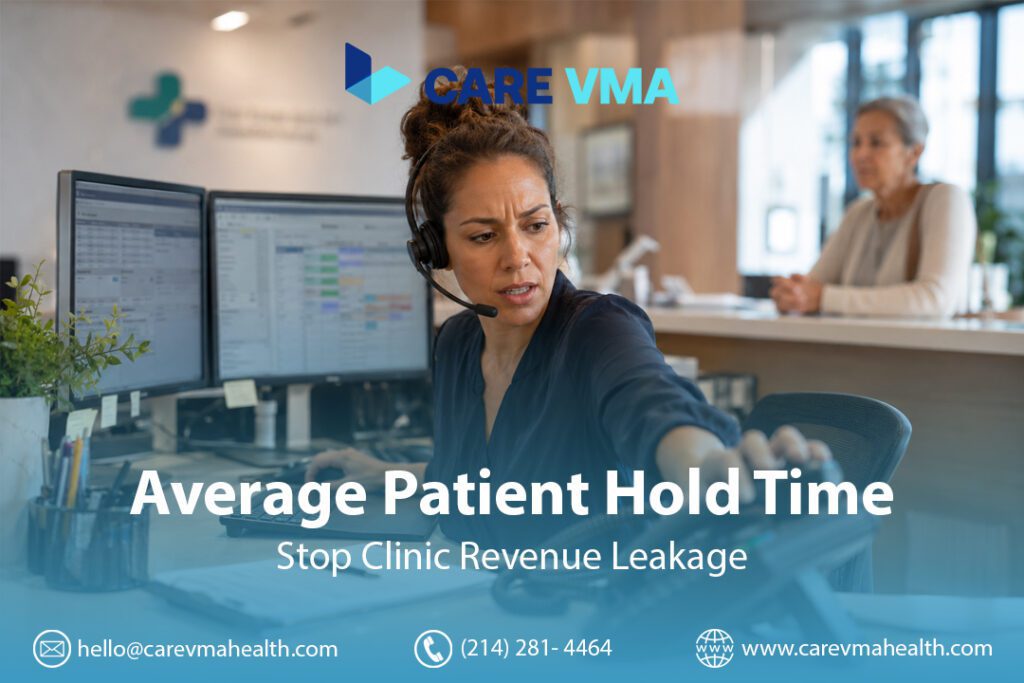
The relentless ringing of phones during peak hours isn’t just a noise nuisance; it’s a symptom of operational overcapacity. For most US-based clinics, the front desk is expected to perform the “impossible trio”: greeting the patient in front of them, answering a triage call, and accurately inputting data into the EHR simultaneously.
This level of multitasking is the primary driver of front-desk burnout in medical clinics, leading to critical errors in patient intake and scheduling. When your staff is overwhelmed, they aren’t providing care—they are surviving the shift. This survival mode damages your practice’s reputation before a patient even meets the provider.
Benchmarking Patient Abandonment: How Long Will Your Patients Truly Wait?
In modern healthcare, industry benchmarks suggest that 60 seconds is the “abandonment threshold.” Statistics show that approximately 60% of patients will hang up if their call isn’t answered within one minute.
High call abandonment rates directly correlate with negative Google Reviews and a decrease in patient Lifetime Value (LTV). To reduce volume without losing patients, practices must shift from fixed physical capacity to elastic virtual support. Understanding how a virtual assistant receptionist can cut call wait time is the first step in moving from a reactive to a proactive patient access strategy.
The Clinical Depth Gap: Why Answering Services and AI Bots Fall Short
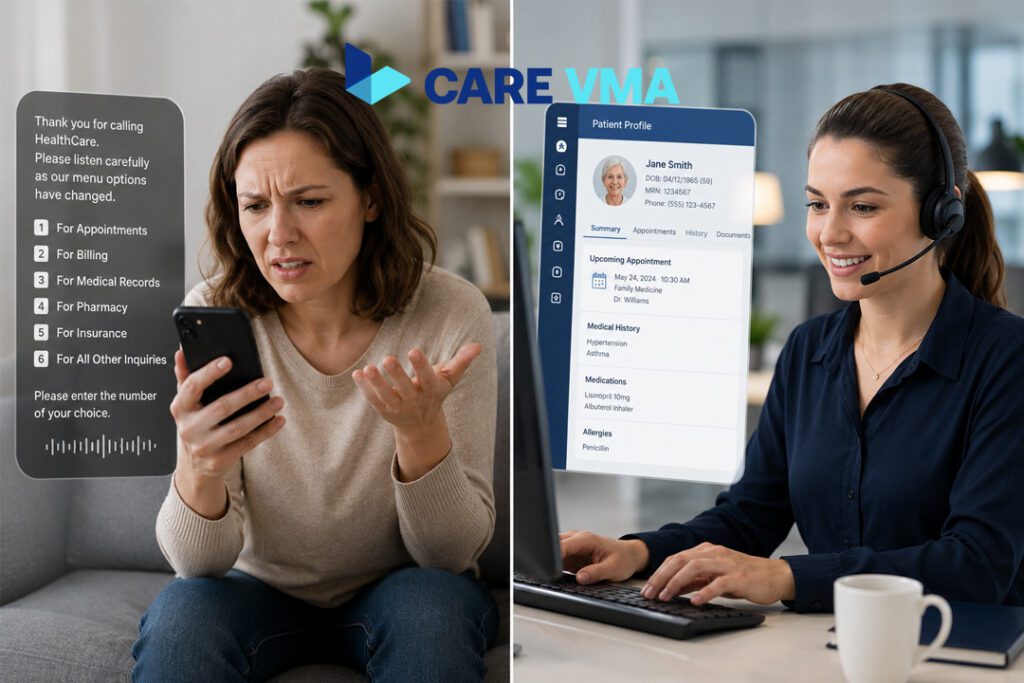
Most clinics attempt to solve high call volumes with IVR systems or generic answering services. However, these often increase patient frustration because they lack “Clinical Depth.”
- The AI/IVR Problem: Patients in pain or distress want to be heard, not “selected” through a menu.
- The Answering Service Flaw: They take messages but rarely resolve issues, creating a “call-back backlog” for your local staff.
- The Care VMA Difference: Unlike a generic service, our Virtual Medical Receptionist functions as a “cloned” staff member—trained in medical terminology, capable of real-time EHR scheduling, and skilled in insurance verification.
Real-Time EHR Integration and Accurate Patient Triage
A VMA doesn’t just “answer” the phone; they process the encounter. By working directly within your EHR (e.g., eClinicalWorks, Athenahealth), they ensure that patient instructions are conveyed and appointments are booked accurately. This prevents the back-office backlog that occurs when local staff try to “catch up” on messages after hours. Refining your patient scheduling workflow through virtual integration ensures that every call results in a scheduled appointment, not just a sticky note on a computer monitor.
Proactive Insurance Verification and Intake
By delegating high-volume calls to a Virtual Medical Assistant, your local staff can focus on the patient in the room. Meanwhile, the VMA handles the heavy lifting of verifying PPO/Medicare eligibility and completing intake forms before the patient ever arrives, ensuring a smoother clinical flow and higher provider productivity.
Workflow Evolution: From Physical Desk Limitations to Elastic Capacity
Use Case: Handling the “Monday Morning Surge”
- The Scenario: A growing multi-specialty clinic receives 50+ calls between 8:00 AM and 10:00 AM every Monday.
- The Old Workflow (Before VMA): Calls go to voicemail, hold times exceed 3 minutes, and front-desk staff report high stress. Patients complain about “never being able to reach a human.”
- The New Workflow (With Care VMA): The VMA intercepts the overflow. While local staff greet in-office patients, the VMA handles 80% of scheduling calls.
- The Result: Hold times drop below 30 seconds, booking rates increase by 20%, and local staff can finally focus on high-touch patient care without the distraction of a ringing phone.
The ROI of Efficiency: Calculating the Cost of a Missed Patient Call
Every missed call is a missed opportunity for a new patient acquisition. If your average patient LTV is $500, losing just five calls a week due to long hold times results in a $130,000 annual revenue leak.
Transitioning to a VMA is not just a cost-saving measure on HR and benefits; it is a revenue-retention strategy that scales with your clinic’s growth without the need for additional office square footage. You can effectively maximize practice potential with a healthcare virtual assistant by turning every phone ring into a captured revenue event.
HIPAA-Compliant Patient Access: Trust and Security in Every Interaction
Security is non-negotiable in US Healthcare. Care VMA ensures all virtual interactions are conducted over secure, encrypted lines with a signed Business Associate Agreement (BAA) in place. Our VMAs are trained specifically in US healthcare regulations, ensuring that “Patient Access” never comes at the expense of data privacy.
Stop the leakage. Protect your staff. Scale your care. Schedule a Front-Desk Efficiency Audit with Care VMA today.
FAQ: Key Questions for Practice Managers
What is a reasonable phone wait time for patients?
Industry data shows that abandonment rates spike after 60 seconds. Leading practices aim to answer 90% of calls within 30 seconds to maintain high patient satisfaction and minimize “leakage” to competitors.
Does an IVR system actually increase appointment cancellations?
Yes, in many cases. If a patient is trying to reschedule or has a specific clinical question, a complex IVR can lead to frustration, causing them to hang up and potentially “no-show” their appointment because they couldn’t reach a human to cancel.
How can I handle call surges without hiring more local staff?
The most cost-effective solution is “elastic capacity” through a Virtual Medical Assistant. A VMA handles the overflow during peak hours and scales support based on your actual volume, saving you the overhead of a full-time physical hire.
What is the financial loss per minute of patient hold time?
Beyond the immediate loss of a new booking, long hold times damage your brand equity. One negative review citing “impossible to reach the office” can deter dozens of potential patients, costing thousands in long-term revenue.
Is a VMA significantly cheaper than a physical administrative hire?
Typically, yes. When you factor in recruitment costs, office space, equipment, health insurance, and payroll taxes, a VMA can reduce administrative overhead by up to 40-50% while providing specialized medical expertise.