The mere mention of an audit can send a wave of anxiety through even the most competent program manager. It often means late nights, frantic searches for misplaced documents, and a lingering fear that one small oversight could lead to disastrous findings. This reactive scramble drains time, resources, and morale. What most people don’t realize is that this stress is a symptom of a broken system, not a necessary part of compliance.
What if you could face an audit notification with confidence, knowing your program is not just prepared, but inherently defensible? Imagine a system where proof of execution is an automatic byproduct of your daily work, not a frantic archeological dig through old emails. This shift from reactive panic to proactive control is the essence of audit-proofing.
Audit-proofing a program is the process of building proactive systems, documentation, and a culture that ensures every action is verifiable and defensible before an external auditor. The goal is to move from reactive stress to continuous control, built on one core principle: “if it wasn’t documented, it didn’t happen.” This guide, built on Care VMA Health’s experience helping dozens of healthcare programs navigate complex HIPAA, grant, and operational audits, will show you how to build that system.
The Four Pillars of an Audit-Proof Program

Building a program that can withstand scrutiny is a lot like building a house. At first glance, it seems complex, but it all rests on a few unshakable foundations. Without them, even the most well-intentioned program will crumble under pressure.
These four pillars are the non-negotiable foundation for creating a culture of constant readiness, turning your documentation from a liability into a strategic asset.
- Pillar 1: Clarity (Simple, Understandable Policies) Your Policy Manual should be a guide, not a legal puzzle. If a procedure is too convoluted for a new team member to understand, it’s almost certainly being executed inconsistently. Policies written in plain language reduce ambiguity and the risk of human error, forming the bedrock of consistent Data Integrity.
- Pillar 2: Accessibility (A Centralized Repository, Not Personal Folders) The “it’s in my email somewhere” defense doesn’t work with auditors. All policies, procedures, and evidence must live in a single, centralized repository. This single source of truth ensures that anyone, from a team member to an auditor, can find the necessary documentation without needing a personal guide, establishing strong Internal Controls.
- Pillar 3: Evidence of Execution (The Most Common Failure) This is where most programs fail. Having a policy is meaningless without proof it was followed. Every critical action requires a timestamp, a digital signature, or a log entry. This is your Defensible Documentation—an irrefutable trail that proves you do what you say you do. Without this Evidence of Execution, your policies are just words on a page.
- Pillar 4: Regular Review (Documentation as a ‘Living’ Asset) Stale policies are dangerous. An audit-proof program treats its documentation as a living asset, not a “set it and forget it” task. An annual review is the bare minimum. You need a system that triggers reviews when regulations change, key personnel leave, or a new process is introduced. This ensures your program adapts and remains compliant.
Audit-Proofing in Action: Framework by Program Type
The core principles of audit-proofing are universal, but their application is highly specific. The evidence you need to prove HIPAA Compliance is vastly different from what’s required for grant fund accountability.
Here’s how to translate the four pillars into concrete actions for the programs you actually run, turning abstract rules into a practical compliance framework.
For Healthcare IT & Software (Beyond Just HIPAA Tech Safeguards)
In tech, the proof is in the logs and commit history. It’s about demonstrating control over your digital environment. This goes beyond simple backups; it’s about proving a secure and auditable development lifecycle. Key actions include implementing immutable logs, which are critical for HIPAA compliance and data security.
- Version Control as a Story: Every code change must be linked to an approved ticket (e.g., in Jira or Azure DevOps). This creates a narrative: why the change was made, who approved it, and when it was deployed.
- Immutable Logging: System access logs, error logs, and user activity logs must be tamper-proof. Auditors need to trust that the logs they are reviewing are an accurate record of what happened.
- Automated License & Dependency Scanning: Maintain a real-time inventory of all third-party software components. An auditor will want to see that you’re not exposed to known vulnerabilities or licensing conflicts.
For Grant & Publicly Funded Programs (Proving Every Dollar’s Impact)
When you’re using public or foundation money, the burden of proof is immense. You must demonstrate not just that money was spent, but that it was spent correctly and achieved the intended purpose.
- The Allowable Cost Test: For every single expense, you must have documentation linking it directly to a grant objective. This means the invoice, proof of payment, and internal approval are all filed together.
- Eligibility Verification Files: If your program serves specific populations, maintain a standardized file for each participant with signed and dated proof of their eligibility. Consistency is key.
- Proactive Subrecipient Monitoring: If you distribute funds to partner organizations, you are responsible for their compliance. Regular “mini-audits” of your partners are essential to prevent their mistakes from becoming your audit finding.
For Business & Compliance Programs (Mapping to HIPAA & SOC 2)
For administrative and operational programs, it’s about connecting your internal rules to external standards. Auditors want to see a clear map from your day-to-day actions to the specific regulations you’re bound by.
- Framework Mapping: Create a crosswalk document that explicitly links your internal policies to specific requirements in frameworks like HIPAA (Administrative Safeguards), SOC 2, or ISO 27001.
- Segregation of Duties (SoD) Proof: It’s not enough to have an SoD policy; you must prove it. System roles and permissions logs should demonstrate that the person who approves an invoice cannot also be the person who pays it.
- Mock Audits & Drills: The best way to test your defenses is to attack them. Conduct an annual mock audit with an internal team or external consultant to find the gaps before a real auditor does.
Your Pre-Audit “Go-Bag”: A 5-Point Checklist
When an auditor calls, the clock starts ticking. Having a pre-assembled “go-bag” of essential documents can turn a moment of panic into a calm, professional response. Think of this as the core file you should be able to produce within minutes, not days.
Here’s what every auditor will ask for first, and why it matters so much.
- Updated Organizational Chart: Auditors use this as a map. They need to know who was responsible for which decisions and controls during the audit period. An out-of-date chart is an immediate red flag.
- Version-Dated Policy Manual: You must provide the specific version of the policy manual that was in effect during the period being audited, not your current one. This proves you were following the declared rules at the time.
- Leadership Meeting Minutes: These minutes provide evidence of governance and oversight. They show the auditor that your leadership team was actively engaged in managing risk and ensuring Regulatory Compliance.
- Prior Audit Findings & Corrective Action Proof: If you had a previous audit, your first test is proving you fixed the problems they found last time. You need the original finding and the documented evidence that a Corrective Action Plan was completed.
- Staff Training Records: This is non-negotiable. You need logs showing which employees were trained on which specific policies (like HIPAA or security awareness) and on what date. This proves your policies are being actively implemented.
Feeling a little overwhelmed by just this short checklist? You’re not alone. Many organizations struggle with the manual effort required to keep these documents current and accessible. This is precisely where a modern approach can make all the difference.
The Proactive Shift: From Manual Chaos to Automated Control
The fundamental problem with traditional audit preparation is that it’s a manual, archeological process. It relies on heroic efforts to find disparate pieces of evidence scattered across inboxes, shared drives, and paper files. This is not sustainable.
The proactive shift is about moving from this manual chaos to a system of automated control. This is where technology, like the Care VMA Health platform, transforms compliance from a burdensome event into a strategic advantage, directly addressing the need for a sustainable, audit-ready culture.
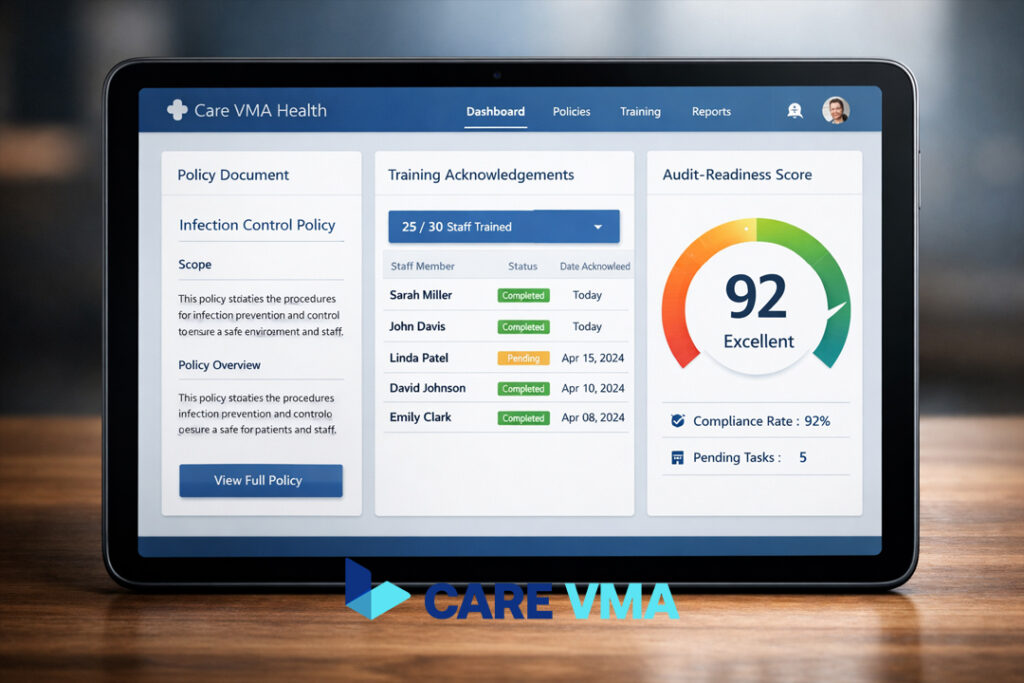
- Reducing the Burden with Automated Evidence: Instead of chasing signatures, imagine a system where a policy update automatically triggers a notification to all relevant staff. Their digital acknowledgment is then logged as Evidence of Execution with a timestamp, creating a perfect audit trail without any manual work. Our virtual medical assistants are trained to manage these systems, ensuring nothing falls through the cracks.
- Boosting Confidence with a Smart Repository: The Care VMA platform acts as the “central nervous system” for your compliance. All policies, training records, meeting minutes, and corrective action plans are stored in one searchable, version-controlled location. An auditor asks for the security policy from last year? You can retrieve it in seconds.
- Building an Audit-Ready Culture: Technology facilitates habits. Automated reminders for annual policy reviews ensure documentation never becomes stale. Dashboards that visualize compliance status make readiness a visible, shared responsibility. This shifts compliance from a once-a-year scramble to a simple, daily routine.
Use Case: Consider a grant program manager responsible for a multi-year federal health grant. Using Care VMA, every invoice uploaded is automatically tagged to the corresponding grant line item. The approval workflow is digitally captured. At any moment, she can generate a complete, audit-ready expense report with all supporting Defensible Documentation in minutes—a task that previously took days of manual reconciliation.
Beyond Compliance: The Tangible Benefits of Being Audit-Proof
Achieving a state of continuous audit-readiness does more than just help you pass an audit. That’s just the baseline. The real value lies in the operational excellence that this discipline creates.
This isn’t just about avoiding fines; it’s about building a stronger, more efficient, and more trustworthy organization.
Significant Cost Savings
Think of the hundreds of staff hours consumed by last-minute audit prep. Now, add the potential for hefty fines for non-compliance with regulations like HIPAA, or the risk of funding clawbacks from grantors. An audit-proof system dramatically reduces these labor costs and financial risks.
Improved Operational Workflow
Clear, accessible, and consistently enforced procedures are the backbone of an efficient operation. The process of audit-proofing forces you to streamline workflows, eliminate redundancies, and clarify responsibilities. The result is a more productive team and a smoother-running organization, optimizing everything from patient intake to medical billing.
Enhanced Trust & Reputation
Being perpetually audit-ready sends a powerful signal to everyone you work with. It tells grantors and investors that you are a responsible steward of their funds. It shows regulators that you take compliance seriously. And most importantly, it demonstrates to patients that you operate at the highest standard of care and data protection.
Comparison: The Reactive Scramble vs The Proactive System
The difference between a traditional approach and an audit-proof system is night and day. One is defined by stress and risk, the other by control and confidence.
| The Reactive Scramble (Traditional Method) | The Proactive System (The Care VMA Way) |
|---|---|
| Manual tracking in spreadsheets & email | Automated evidence collection |
| Data lives in disconnected silos | Central source of truth |
| Dependent on a single “compliance hero” | System-dependent, not person-dependent |
| Last-minute panic and disruption | Always audit-ready, business as usual |
| High risk of error and missing documents | Minimized risk through verified trails |
| Stressful, unpredictable, and expensive | Calm, predictable, and cost-effective |
Explore Further Resources
Building an audit-proof program is a journey. As you strengthen your compliance framework, these resources can provide deeper insights into specific areas:
- Article: Learn the fundamentals with our complete HIPAA Compliance Checklist for Healthcare Providers.
- Service Page: See how Care VMA’s Compliance Management Platform can automate the framework discussed in this guide for your practice.
Frequently Asked Questions
Getting started can feel like the hardest part. Here are answers to a few common questions that managers have when they begin this process.
What is the first step to make my program audit-proof?
The first step is a self-assessment. Map out your current policies, identify where all your critical documents are stored, and ask yourself, “How do I prove we follow this rule?” This exercise will quickly reveal your biggest gaps and vulnerabilities.
How often should I review policies and procedures?
At a minimum, all policies should be reviewed annually. However, a review should also be immediately triggered by significant events, such as new regulations (like the updates from the Office for Civil Rights), changes in key leadership, or after any compliance incident.
What is “defensible documentation”?
Defensible documentation is evidence that provides a complete, standalone audit trail. It clearly answers who, what, when, and why for any critical action, and it’s strong enough to withstand an auditor’s scrutiny without needing additional verbal explanation or clarification.
Conclusion & The Path to Peace of Mind
Becoming audit-proof isn’t about achieving an impossible standard of perfection. It’s about taking control. It’s a fundamental shift from fearing audits to using them as a benchmark for operational excellence. By building a proactive system founded on clarity, accessibility, evidence, and review, you create a program that is not just compliant, but resilient, efficient, and trustworthy. You have the power to transform audit anxiety into the peace of mind that comes from being prepared by default.
Ready to stop scrambling and start building a truly defensible program?
Don’t wait for the audit notification to arrive. Take the first step towards proactive control and lasting peace of mind.