For many practice managers, the front desk feels like a revolving door. A talented receptionist is hired, trained, and integrated into the team, only to resign a year later, citing stress and exhaustion. The cycle repeats, leaving you to deal with constant recruitment, training disruptions, and inconsistent patient experiences. This isn’t a series of isolated incidents; it’s a systemic operational failure known as medical front desk burnout.
This chronic stress doesn’t just impact morale—it directly erodes your practice’s bottom line through high staff turnover, administrative errors, and lost revenue. The solution isn’t just another “staff wellness” seminar. It’s an operational upgrade that permanently removes the root causes of this burnout. By strategically delegating administrative tasks to a specialized Virtual Medical Assistant (VMA), you can stabilize your team, improve efficiency, and reclaim your focus on patient care.
The Hidden Crisis Costing Your Practice: Identifying Front Desk Burnout
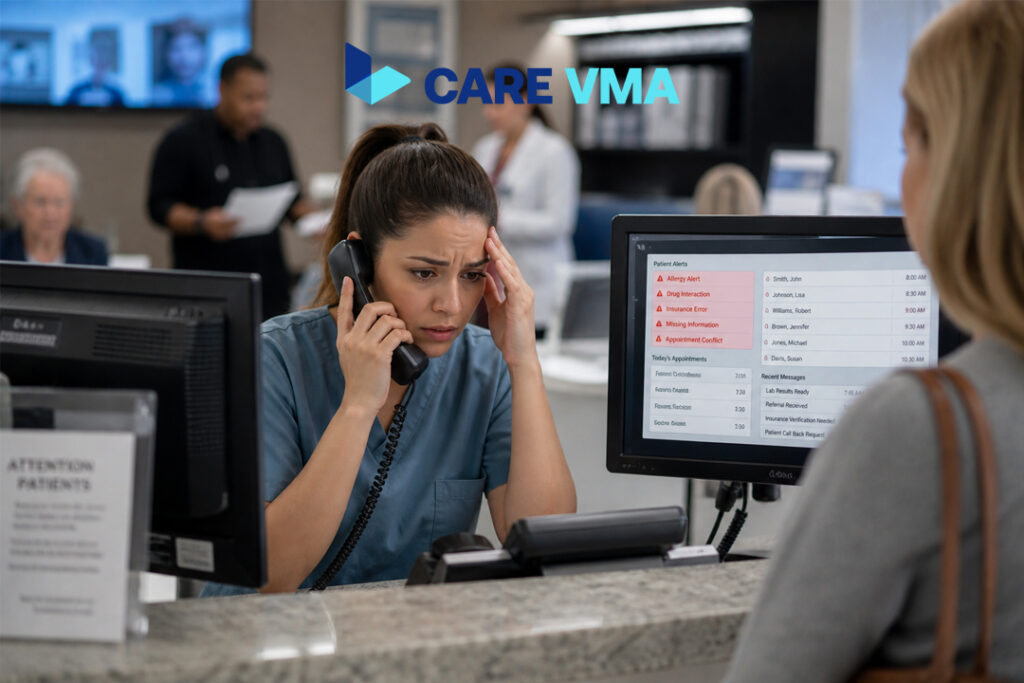
Front desk burnout is a quiet crisis. Unlike clinical burnout, which is widely discussed, the administrative equivalent often goes unnoticed until a resignation letter appears. However, with nearly 46% of non-clinical staff reporting burnout symptoms, ignoring the issue is a significant financial risk. The pressure on your front-line team is immense, stemming from a broken workflow, not a lack of effort.
More Than a Bad Day: The Core Drivers are Multitasking, Manual Overload, and Patient Aggression
The modern medical receptionist role is often an impossible one. Staff are expected to be empathetic customer service agents, meticulous data entry clerks, and firm financial coordinators—all at the same time. This unsustainable pressure is caused by three primary factors:
- Constant Context Switching: Juggling a ringing phone while checking in a patient and simultaneously trying to verify insurance information creates intense cognitive load, leading to decision fatigue and errors.
- Manual Task Overload: Repetitive tasks like phone-based appointment reminders, transcribing intake forms, and managing referral paperwork are time-consuming and emotionally draining.
- Patient Aggression: Front desk staff are on the front line of patient frustration, absorbing anger about wait times, billing issues, and insurance denials—factors often outside their control.
Early Warning Signs Your Team is Approaching Burnout (Increased Errors, Presenteeism)
Before a valued team member quits, the signs of burnout are already damaging your practice. Be vigilant for these red flags:
- Increased Administrative Errors: A spike in scheduling mistakes, incorrect patient data entry, or missed copay collections.
- “Presenteeism”: Staff are physically present but mentally and emotionally disengaged. Their productivity drops, and their interactions with patients become transactional and devoid of empathy.
- A Rise in Patient Complaints: An increase in negative reviews or direct complaints mentioning “rude staff,” “long hold times,” or a “chaotic” check-in process.
How to Reduce Front Desk Burnout in 3 Steps with a Virtual Assistant
Tackling burnout requires redesigning the workflow, not just managing the symptoms. A Virtual Medical Assistant is the catalyst for this change, allowing you to re-engineer your front office for efficiency and resilience.
Step 1: Audit Your Current Administrative Bottlenecks
Identify the tasks that create the most pressure. Is it the constant phone interruptions? The time spent on insurance verifications? Or the manual process of appointment reminders? Pinpointing these high-volume, low-value tasks is the first step toward offloading them.
Step 2: Offload High-Volume, Low-Value Tasks to a Dedicated VMA
Delegate the administrative work that can be done remotely to a trained professional. A Virtual Medical Receptionist from Care VMA can manage the majority of your inbound calls, schedule appointments directly in your EHR, handle insurance pre-authorizations, and process referrals—all without interrupting your in-office flow.
Step 3: Empower Your On-Site Staff to Focus on Patient Experience and In-Person Collections
With the administrative chaos handled remotely, your on-site staff are free to transform their role. They can now provide a welcoming, high-touch check-in experience, focus on collecting outstanding balances, and manage the patient flow in the clinic without distraction. This not only improves job satisfaction but also directly boosts patient satisfaction and revenue. For a deeper look at this model, many practices are exploring the differences between a virtual receptionist vs. a traditional receptionist to build their business case.
The True Financial Impact: Calculating the Cost of Burnout on Your Bottom Line
Medical front desk burnout is not an HR issue; it’s a financial one. Each time a receptionist quits, the direct and indirect costs can be crippling for a private practice. Understanding these numbers is key to justifying an investment in a sustainable solution.
The $12,000 Problem: The Real Cost of Recruiting and Training a New Receptionist
Industry data shows the cost of replacing a single front desk employee is between $9,000 and $12,000. This figure accounts for recruitment agency fees, advertising costs, management time spent on interviews, and up to six months of lost productivity while the new hire gets up to speed. For many clinics, this happens every 12-18 months per position, creating a predictable and avoidable budget drain.
How “Rude Staff” Reviews Are Directly Linked to Burnout and Patient Attrition
Go through your 1-star reviews on Google or Healthgrades. They rarely question a physician’s clinical skill. Instead, they focus on long hold times, scheduling errors, and interactions with “rude” or “unhelpful” staff. These are not character flaws; they are the direct symptoms of a burned-out employee who lacks the capacity to be patient and empathetic. Each negative review deters dozens of potential new patients from booking an appointment.
Identifying Revenue Leakage from Burnout-Related Errors and Missed Follow-ups
An overwhelmed staff member is more likely to make costly mistakes. This includes:
- Failing to collect copays and deductibles at the time of service.
- Incorrectly entering insurance details, leading to claim denials.
- Neglecting to follow up on no-shows to reschedule appointments.
- Forgetting to confirm appointments, increasing the no-show rate.
Each of these small errors accumulates into thousands of dollars in lost revenue per month.
A Clinic Workflow Transformed: Before vs. After a Care VMA

Visualizing the change is the best way to understand the impact of integrating a Virtual Medical Assistant. It’s a fundamental shift from a chaotic, reactive front desk to a calm, proactive one. The goal is to achieve clinic workflow optimization by separating remote tasks from in-person ones.
Scenario Before: One Receptionist Juggling a Ringing Phone, an In-Person Check-in, and an Insurance Call
The phone is ringing with a patient wanting to book a new appointment. At the same time, a patient is standing at the desk trying to check in, and the receptionist has been on hold with an insurance company for 10 minutes. In this scenario, all three tasks are performed poorly. The patient on the phone gets rushed, the patient at the desk feels ignored, and the insurance call might get dropped, forcing the process to start over. This is the daily reality that causes medical front desk burnout.
Scenario After: Your On-Site Staff Provides Focused Patient Care While Your VMA Manages 80% of Phone Traffic and Scheduling
Your Care VMA is handling the inbound call, scheduling the appointment directly into your EMR. Your on-site staff member greets the checking-in patient with their full attention, answers their questions, and collects their copay. The long insurance verification call was completed by the VMA earlier that morning. The environment is calm, professional, and efficient. The patient feels valued, and your staff member feels effective and in control.
Use Case: Optimizing Your Appointment Confirmation and No-Show Reduction Process Remotely
A dedicated VMA can implement a proactive patient outreach strategy. Two days before an appointment, they call patients to confirm, answer any last-minute questions, and provide pre-visit instructions. This simple, focused workflow, unburdened by in-office distractions, can reduce your no-show rate by over 50%, directly recapturing thousands in lost appointment revenue each month.
The ROI of a Virtual Medical Assistant vs In-House Staff
When practice owners compare hiring another in-house receptionist to engaging a VMA service, they often focus only on the hourly rate. The real financial calculation, however, must include the hidden costs of a traditional employee and the revenue-generating potential of a VMA. This is where you can calculate a true virtual medical receptionist ROI.
A Clear Cost-Benefit Analysis: VMA vs Full-Time Employee with Benefits
A full-time employee comes with significant overhead beyond their salary: payroll taxes, health insurance, retirement benefits, paid time off, and workers’ compensation. A Care VMA has none of these associated costs. You pay only for productive hours, converting a fixed overhead cost into a flexible operational expense that scales with your needs.
Recapturing Revenue by Reducing Your No-Show Rate Through Proactive VMA Follow-up
As mentioned in the use case, proactive appointment confirmation is a task perfectly suited for a VMA. If a VMA prevents just three to four no-shows per week, the recaptured revenue from those appointments often covers the entire cost of the service, making everything else they do—like answering phones and verifying insurance—a net profit for your practice.
Eliminating Turnover Costs for a Predictable, Stable Operational Budget
By solving the root cause of medical front desk burnout, you break the expensive cycle of hiring and retraining. Care VMA provides a consistent, reliable team of professionals, eliminating the $12,000 replacement cost from your budget. This creates a stable, predictable operational model and allows you to invest those savings back into patient care and practice growth.
Seamless, Secure, and Professional: The Care VMA Commitment
Adopting a new operational model can feel daunting, which is why we’ve designed our service to be a seamless extension of your existing practice. We prioritize security, professionalism, and effortless integration to ensure a smooth transition and immediate positive impact.
Our 100% HIPAA-Compliant VMA’s: Trained Professionals, Not Just an Answering Service
Every Care VMA is a trained healthcare professional who understands the importance of patient privacy and data security. We operate under strict, 100% HIPAA-compliant protocols, ensuring all patient health information (PHI) is handled with the utmost care. Unlike a generic answering service, our VMAs understand medical terminology and clinic workflows, representing your practice with the professionalism your patients expect.
Effortless Integration with Your Existing EHR and Practice Management System
Our team is proficient with all major EHR and Practice Management systems, including Epic, Cerner, Athenahealth, and eClinicalWorks. We integrate directly into your existing technology stack through secure connections. There are no new systems for you to learn. Your Care VMA functions just like an in-house employee, managing schedules and patient data within the platforms you already use every day.
Frequently Asked Questions by Practice Managers
What is the true ROI of a Virtual Medical Assistant when factoring in staff turnover costs?
When you factor in eliminating the average $12,000 cost to replace a front desk employee, plus recapturing revenue from reduced no-shows and more efficient copay collection, the ROI is significant. Most practices find that a VMA pays for itself and generates a positive return within the first few months by plugging these critical financial leaks.
Is a Virtual Medical Assistant better than just buying automation software?
Automation software is a great tool, but it can’t handle nuanced patient conversations, solve complex scheduling conflicts, or show empathy to a frustrated patient on the phone. A VMA combines the efficiency of technology with the critical human touch that is essential in healthcare. They manage the software and fill the gaps where automation falls short.
How does a VMA address the fact that nearly half of front desk staff are burned out?
A VMA addresses burnout by directly removing the primary stressors: the overwhelming volume of inbound calls and repetitive administrative tasks. By delegating 80% of this workload, you allow your on-site staff to work at a sustainable pace, focus on higher-value tasks, and engage meaningfully with the patients in front of them, drastically improving job satisfaction and retention. It is one of the most effective solutions for how medical virtual assistants reduce burnout.
How does the onboarding process for a Care VMA work with our existing team and systems?
Our onboarding is designed to be simple and minimally disruptive. We start with a discovery call to understand your specific workflows, challenges, and EHR system. We then assign a dedicated VMA (or team) to your practice and conduct a structured training process where we learn your protocols. We typically begin by handling one task (like phone calls) and gradually expand our support as your team becomes more comfortable. The entire process is managed by a dedicated account manager to ensure a smooth transition.
Ready to stop the revolving door and build a more resilient, profitable practice?
Schedule a free consultation today to discover how a Care VMA can solve your front desk challenges and deliver a measurable return on your investment.