
The core promise of primary care—longitudinal, patient-focused relationships—is being buried under an avalanche of administrative work. Physicians and practice managers report spending more time managing EHR inboxes, chasing prior authorizations, and handling paperwork than engaging in patient care. This isn’t just a frustration; it’s a critical flaw in the modern practice model, leading to burnout, staff turnover, and missed revenue. The challenge for 2026 isn’t about working harder; it’s about re-engineering your practice to stop managing tasks and start engineering efficiency.
The Administrative Overload That’s Crippling Your Practice’s Efficiency
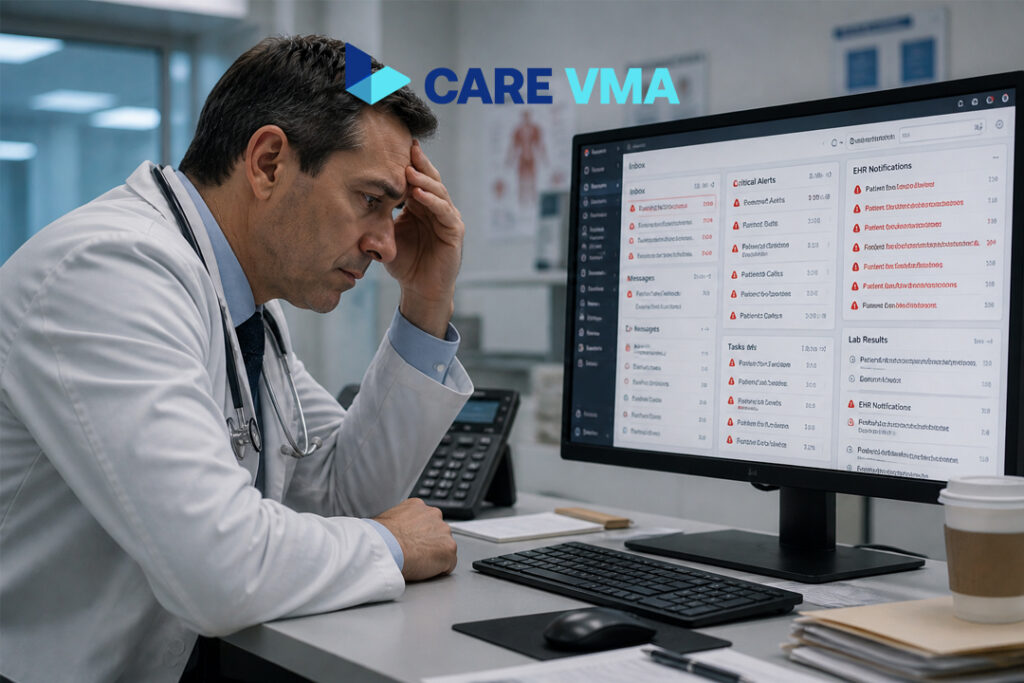
Modern inefficiency is a complex problem born from a combination of digital burden, persistent staffing gaps, and the increasing documentation demands of value-based care. While Electronic Health Records (EHRs) promised a digital utopia, they often delivered “death by a thousand clicks,” turning highly-trained clinicians into data-entry clerks. This administrative drag is the single greatest barrier to achieving higher primary care practice efficiency, creating bottlenecks that ripple through every aspect of your operations.
How Inefficiency Directly Impacts Your Revenue, Staff Retention, and Patient Care
Operational friction isn’t just an annoyance; it has tangible, negative consequences for your practice’s financial health and stability. Every minute a physician spends on a non-billable administrative task is a minute they aren’t providing patient care, generating revenue, or working at the top of their license.
The Hidden Costs of “Death by a Thousand Clicks”: Linking EHR Tasks to Provider Burnout
The constant stream of portal messages, refill requests, and lab result notifications creates a significant cognitive load, contributing directly to physician burnout. Burnout isn’t just a personal issue; it’s an operational crisis that leads to reduced productivity, increased medical errors, and the potential loss of your most valuable asset—your clinicians. Investing in solutions that systematically reduce burnout in US healthcare practices is no longer a luxury but a core business strategy.
Why Your Best MAs Leave: The Financial Drain of High Staff Turnover
Your most capable Medical Assistants (MAs) are often overwhelmed by the sheer volume of repetitive administrative work, from phone calls to faxes. When they leave due to this strain, your practice incurs significant costs in recruitment, hiring, and training their replacement. This turnover cycle perpetuates inefficiency, as new staff require time to get up to speed, and patient care continuity suffers.
Why Traditional Staffing and Standalone Software Can’t Solve the Efficiency Equation
Attempting to solve systemic inefficiency by simply hiring more in-house staff often just adds to your overhead without fundamentally fixing broken workflows. Likewise, single-purpose software tools can create more digital fragmentation, forcing your team to manage yet another login and interface. The solution isn’t another task-doer or another app; it’s a strategic partner that integrates into your existing workflows to offload administrative burdens entirely. This is where a Virtual Medical Assistant (VMA) becomes the central nervous system for a modern, efficient practice.
How to Enhance Primary Care Efficiency in 4 Steps with a Virtual Medical Assistant (VMA)
A Virtual Medical Assistant from Care VMA isn’t just an extra set of hands; it’s a dedicated, remote team member trained to manage your high-volume, low-complexity administrative workflows. They allow you to re-engineer your operations by delegating specific, time-consuming processes.
- Delegate all non-clinical inbox and portal message management. Your VMA can filter, categorize, and draft responses for routine patient queries, flagging only the clinically urgent messages for physician review.
- Offload the end-to-end prior authorization and referral process. Stop losing hours to phone trees and fax machines. A dedicated virtual medical assistant manages the entire lifecycle of prior auths and referrals, from submission to follow-up.
- Automate pre-visit chart preparation and insurance verifications. Ensure every patient chart is fully prepared before the encounter, with all necessary documentation, lab results, and insurance details confirmed and ready for the physician.
- Systematize post-visit order entry and care gap follow-ups. Your VMA can enter lab and imaging orders, coordinate with specialists, and manage patient follow-ups to close care gaps, ensuring no task or revenue opportunity is missed.
A Day in an Efficient Practice: The VMA-Driven Workflow

Imagine a practice where clinicians arrive to fully prepped charts, spend their visits focused entirely on the patient, and end the day with minimal administrative clean-up. This level of clinic workflow optimization is achievable by integrating a VMA across the patient lifecycle.
Pre-Visit Automation: Clearing Administrative Hurdles Before the Patient Arrives
Instead of scrambling in the morning, your VMA has already worked through the next day’s schedule. Insurance eligibility is confirmed, necessary prior authorizations are in process, and relevant medical records from other facilities have been requested and attached to the patient’s chart.
Live-Visit Support: How VMAs Function as a Real-Time Scribe and Order Manager
During the patient visit, the physician can focus on the conversation while a Virtual Medical Scribe documents the encounter in the EHR in real-time. The VMA can simultaneously queue up lab orders, prescription requests, and referrals based on the physician’s dictation, cutting documentation time by over 50%.
Post-Visit Closure: Ensuring No Revenue is Left Behind in Referrals and Billing
The moment a visit ends, the VMA takes over. They finalize the referral to the specialist, ensure all orders are correctly submitted, and check that the billing codes captured during the scribe-supported encounter are complete, preventing revenue leakage.
From Chaos to Control: Systematizing Your Prescription Refill Workflow
The endless stream of prescription refill requests is a major source of interruption. A VMA-driven workflow turns this chaos into a controlled process. The VMA receives all requests, checks the patient’s chart for eligibility, queues the renewal for physician sign-off, and communicates the status to the pharmacy and patient, all without interrupting a clinician.
The Tangible ROI: Measuring the Financial Impact of VMA Integration on Your Practice
Shifting to a VMA model isn’t an expense; it’s an investment with a clear and calculable return. By moving beyond abstract benefits, you can quantify the precise financial uplift for your practice.
Calculating Your Cost Savings: Reduced Administrative Overhead vs. In-House Staffing
Compare the fully-loaded cost of an in-house MA (salary, benefits, insurance, payroll taxes, paid time off, and training) to the straightforward cost of a Care VMA. A virtual assistant eliminates these overheads, providing expert support for a fraction of the cost, often saving practices 40-60% on administrative staffing expenses.
Unlocking New Revenue: How VMAs Help Capture G2211 and TCM Code Reimbursements
When clinicians are unburdened from administrative tasks, they have the time and focus to manage complex longitudinal care. A VMA can help operationalize the documentation and coordination required for codes like Medicare’s G2211 (longitudinal care) and Transitional Care Management (TCM), capturing revenue that was previously left on the table due to time constraints.
A Partner in Compliance: Ensuring HIPAA Security and Seamless EHR Integration
Entrusting patient data to a remote team member requires absolute confidence in their security protocols. Care VMA understands this is a primary concern for any practice. Our entire operational framework is built around security and compliance. All our Virtual Medical Assistants are fully trained on HIPAA regulations and operate through secure, encrypted platforms. We ensure that our HIPAA-compliant virtual assistants can integrate seamlessly and safely into your existing EHR, providing peace of mind alongside unparalleled efficiency.
Ready to stop managing tasks and start engineering true practice efficiency? Schedule a consultation with a Care VMA workflow expert today and discover how we can unburden your clinicians and unlock your practice’s full potential.
FAQ: Answering Your Key Questions About Virtual Medical Assistants
How does a Care VMA differ from a standard answering service or a freelance assistant?
A Care VMA is a dedicated, professionally managed team member integrated into your practice. Unlike an answering service that only takes messages, our VMAs perform complex administrative and clinical support tasks within your EHR. Unlike a freelancer, our VMAs are backed by a HIPAA-compliant organization that handles training, management, and quality assurance.
What is the onboarding and training process for integrating a VMA into our specific workflow?
We assign a dedicated implementation manager who works with you to document your specific workflows, from prior authorizations to prescription refills. We then train your VMA on these exact processes and your EHR system before they begin, ensuring a seamless integration from day one with minimal disruption to your team.
Are your Virtual Medical Assistants proficient with major EHRs like Epic, Cerner, and Athenahealth?
Yes. Our VMAs have extensive experience and receive ongoing training on all major EHR platforms. We match you with a VMA who is already proficient in your specific system to accelerate the onboarding process and guarantee operational competence.
How do you guarantee data security and HIPAA compliance with a remote assistant?
We employ multiple layers of security. Our VMAs work on encrypted, company-managed devices within a secure network. Access to your systems is logged and monitored, and all team members undergo rigorous, continuous HIPAA training and sign strict confidentiality agreements.
Can a VMA help my practice transition more effectively to value-based care models?
Absolutely. Value-based care requires robust data management, patient outreach, and care coordination—tasks that are perfect for a VMA. By handling care gap reminders, managing patient registries, and coordinating with other providers, a VMA provides the administrative backbone needed to succeed in value-based arrangements.