Burdened by an endless cycle of administrative tasks but deeply concerned about the risks of a HIPAA breach? You’re not alone. Many practice managers and clinic owners feel trapped between operational overload and the legal complexities of protecting patient data. The need for support is clear, but delegating tasks that involve Protected Health Information (PHI) feels like a significant risk.
A HIPAA Compliant Virtual Assistant is a remote administrative professional specifically trained to manage clinic operations and handle PHI within the strict security framework of the Health Insurance Portability and Accountability Act. Unlike a general VA, they operate under a signed Business Associate Agreement (BAA), use encrypted tools, and follow audited workflows to securely manage tasks like patient scheduling, billing, and EMR data entry. This allows practices to reduce administrative burden without compromising compliance.
This isn’t just about hiring a person; it’s about implementing a secure, pre-built operational system. Let’s walk through exactly how that system works to protect your practice and reclaim your time.
The Real Problem: Your Clinic is Leaking Time and Facing Hidden Risks
Every minute your skilled in-house staff spends on the phone chasing down prior authorizations or manually entering patient data is a minute not spent on high-value, patient-facing care. This is where most practices struggle. The administrative burden isn’t just a nuisance; it’s an operational bottleneck with serious consequences.
- Staff Burnout: Your front desk team is juggling ringing phones, patient check-ins, and a mountain of paperwork. This constant multitasking leads to exhaustion, higher turnover, and a greater risk of human error.
- Operational Inefficiency: Repetitive tasks like appointment reminders, insurance follow-ups, and referral coordination steal hours from every day. This backlog slows down your entire revenue cycle and impacts patient experience.
- Hidden Compliance Gaps: In a rushed environment, it’s easy for security protocols to slip. Using personal devices for work or communicating through non-secure channels can create significant, and often unseen, HIPAA vulnerabilities.
Hiring another full-time employee is an expensive, time-consuming process that often doesn’t solve the core workflow inefficiency. You need a more flexible, secure, and cost-effective solution.
Beyond the Checklist: A VA That’s an Extension of Your Compliance Strategy
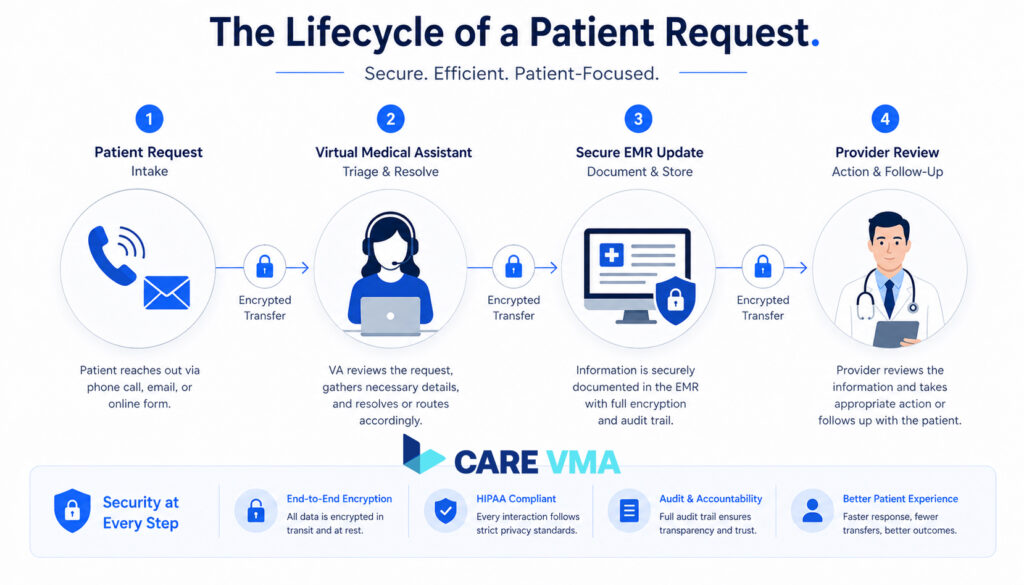
The solution is not just finding “help,” but integrating a secure operational partner. A true HIPAA-compliant virtual assistant is more than a remote worker who has completed a training course; they are part of a comprehensive security and workflow system.
This is a fundamental shift in perspective. Instead of viewing HIPAA as a checklist of rules, we treat it as the blueprint for our entire operational framework. Our virtual medical assistant services are built on a foundation of security, ensuring that every task is performed within a controlled, monitored, and compliant environment.
How It Actually Works: A Day in the Life of Your Secure VMA
So, what does this look like in practice? It sounds complex, but the system is designed to be seamless. Let’s move beyond theory and look at how a trained VA integrates into your clinic’s daily activities.
Workflow #1: Onboarding a New Patient, Securely
A new patient calls to book their first appointment. This is a critical first impression and a major PHI touchpoint.
- Initial Contact: Your Care VMA, acting as your virtual medical receptionist, answers the call. They follow a customized script to represent your practice professionally while gathering initial, non-sensitive demographic details.
- Secure Information Transfer: Instead of emailing sensitive intake forms, the VA sends the patient a direct link to your secure, HIPAA-compliant patient portal. This ensures no PHI is ever transmitted over standard, unencrypted email.
- EMR Data Entry: Once the forms are complete, the VA accesses your EMR through a secure, encrypted VPN connection with role-based permissions. They create the new patient record, upload the completed forms, and schedule the appointment according to your clinic’s protocols. This process is covered in-depth in our patient scheduling workflow guide.
- Audit Trail: Every action—from logging in to creating the record—is logged. As the practice manager, you have a clear, auditable trail of who accessed the patient’s record and when.
Workflow #2: Taming the Prior Authorization and Eligibility Gauntlet
Prior authorizations are one of the biggest time sinks in any medical practice. A secure VA can take this entire process off your plate.
- Task Assignment: Your clinical team flags a patient in the EMR who requires prior authorization for a procedure or medication.
- Secure Document Handling: The VA is notified and accesses the necessary clinical notes through their restricted, often “read-only,” EMR access. They navigate to the specific insurer’s portal to submit the request.
- The Follow-Up Loop: This is where the magic happens. The VA manages the entire follow-up process—including sitting on hold with insurance companies, documenting reference numbers, and checking for status updates. This single workflow can free up hours of your staff’s time each week.
- Real-Time Documentation: All updates, reference numbers, and final approval documents are logged directly in the patient’s EMR file, providing a single source of truth for your billing and clinical teams.
The Care VMA Security Framework: Your 4 Layers of Protection
Handing over access to your systems requires immense trust. That trust is built on a transparent and multi-layered security framework that goes far beyond a simple BAA. Here’s how we protect your practice and your patients.
Layer 1: The Legal Foundation – The Business Associate Agreement (BAA)
This is the non-negotiable first step. The BAA is a legally binding contract that makes Care VMA directly liable for protecting your PHI according to HIPAA standards. No work or system access ever begins without a signed BAA in place.
Layer 2: The Technology Shield – Encryption & Secure Access
We implement strict technical safeguards to create a secure perimeter around your data.
- End-to-End Encryption: All data, whether being sent (in-transit) or stored (at-rest), is scrambled and unreadable to unauthorized parties.
- Secure VPN & Role-Based Access Control (RBAC): Our VAs connect to your systems through a single, monitored gateway. We work with your practice to grant “least-privilege” access—meaning they can only see and do exactly what is required for their specific tasks (e.g., a scheduling VA cannot see billing information).
Layer 3: The Human Firewall – Rigorous Training & Vetting
Technology is only half the battle. Our VAs are meticulously vetted and trained to be a reliable human firewall.
- Continuous HIPAA Training: Beyond a one-time certificate, our VAs undergo mandatory, ongoing training and scenario testing on HIPAA compliance and data security.
- Professional Vetting: All our team members undergo comprehensive background checks and are selected for their experience and professionalism in healthcare settings.
Layer 4: The Accountability Engine – Audits & Reporting
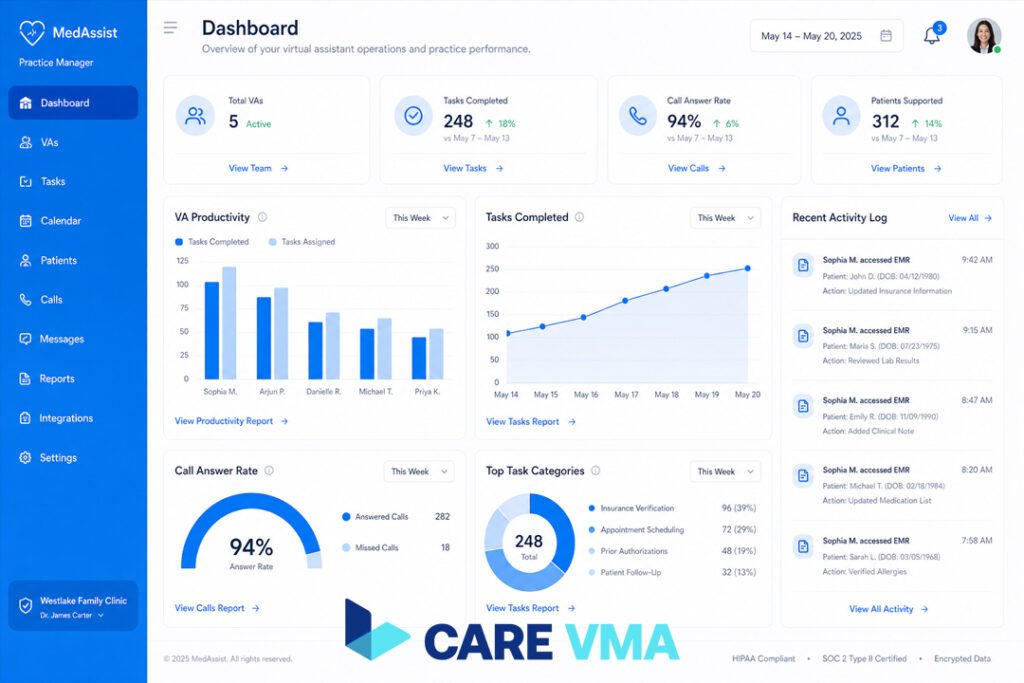
This is what provides true peace of mind. You don’t have to wonder if protocols are being followed—you can see it. We provide you with access to activity logs and regular performance reports, ensuring complete transparency and oversight of all tasks performed.
What a Care VMA Takes Off Your Plate?
By integrating this secure system, you can confidently offload a wide range of administrative and non-clinical tasks, allowing your team to operate at the top of their licenses.
- Front-Desk Operations: Answering phones, scheduling and rescheduling appointments, managing cancellations, and sending patient reminders.
- Revenue Cycle Support: Insurance verification and prior authorizations, managing billing data entry, and handling basic co-pay and statement questions.
- Administrative Tasks: EMR data entry, referral coordination, managing digital faxes, and transcribing non-clinical notes.
- Patient Communication: Handling non-clinical patient follow-ups, answering appointment queries, and providing patient portal support.
Ready for a Calmer, More Secure, and More Efficient Clinic?
Your practice doesn’t have to be a constant source of administrative stress. By implementing a secure VA system, you can reclaim your time, reduce team burnout, and focus on what truly matters: your patients. The real risk isn’t in delegation; it’s delegating without a secure, healthcare-native system designed to protect you.
Your Next Step: A No-Obligation Operational Workflow Consultation
Let’s move from hypothetical to practical. In a brief, no-obligation call, we can:
- Map out one of your current, most time-consuming workflows.
- Show you exactly where and how a secure virtual assistant can integrate.
- Provide a clear, actionable plan to safely delegate tasks and improve your clinic’s efficiency.
Book Your Free Workflow Consultation Today
Frequently Asked Questions (FAQ)
Can a virtual assistant really use my EMR/EHR system securely?
Absolutely. We establish secure, role-based access through an encrypted VPN. This ensures the VA can only access the specific parts of the EMR necessary for their assigned tasks, like scheduling or data entry. We have experience integrating with all major EMR platforms.
How is this different from hiring a freelancer on a platform like Upwork?
The difference is the system versus the individual. A freelancer is just a person who may or may not have proper training or security measures. Care VMA provides a fully vetted professional working within an established security infrastructure that includes a BAA, continuous training, secure technology, and auditable activity logs. We take on the compliance responsibility so you don’t have to.
What happens if there is a potential data breach?
Our signed Business Associate Agreement (BAA) explicitly outlines our legal responsibility and a clear incident response plan. In line with HIPAA regulations, we have strict protocols to immediately identify, contain, notify, and report any potential breach, working in full transparency with your practice.
How quickly can we get started?
Our streamlined onboarding process is designed for busy clinics. It typically takes 5-7 business days, which includes the initial workflow consultation, BAA signing, matching you with the right VA, and completing the secure systems integration.