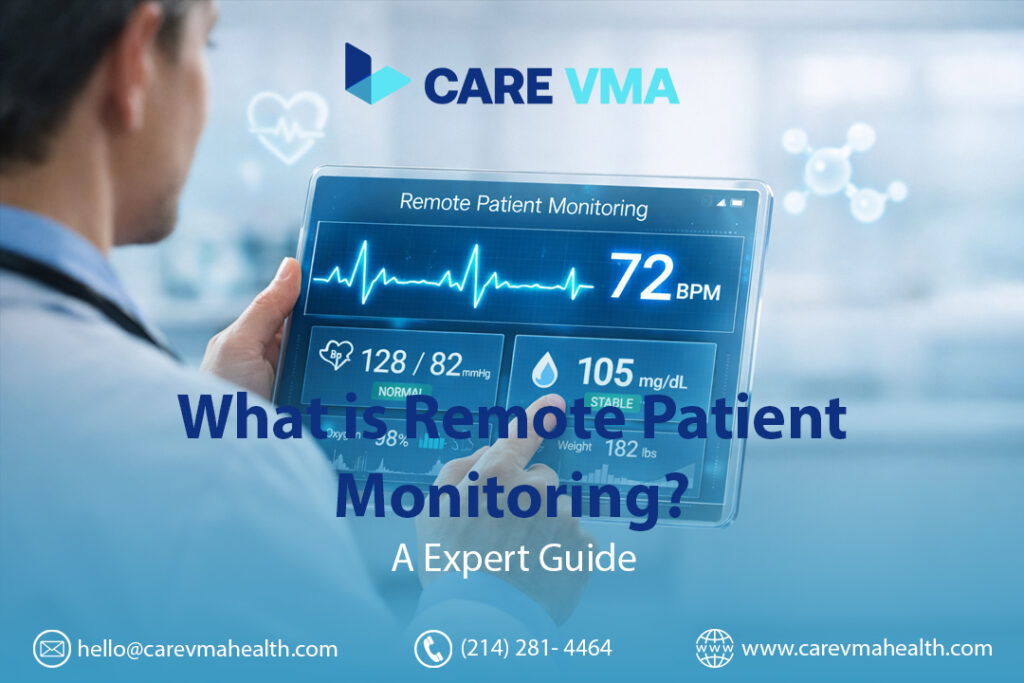
Managing a chronic condition like high blood pressure or heart failure can often feel like a stressful guessing game between doctor’s appointments. You’re left wondering if that new twinge is normal or a warning sign, and you never truly know what’s happening with your body day-to-day. This uncertainty is exhausting. Every minor symptom can trigger a wave of anxiety, while frequent, time-consuming trips to the clinic only add to the burden.
But what if you had a direct, digital line to your care team, with a “guardian angel” watching over your vital signs every single day from the comfort of your home? That’s the powerful promise of Remote Patient Monitoring (RPM).
Remote Patient Monitoring (RPM) is a modern healthcare method that uses digital technology to safely collect patient health data—like blood pressure, blood glucose, and body weight—from their home. This physiologic data is then securely transmitted to healthcare providers, allowing them to proactively monitor chronic conditions, detect issues early, and intervene before they become emergencies.
Information in this guide has been medically reviewed by the clinical team at Care VMA Health to ensure accuracy and relevance according to 2026 standards of care.
How Does Remote Patient Monitoring Actually Work? A Simple 4-Step Process
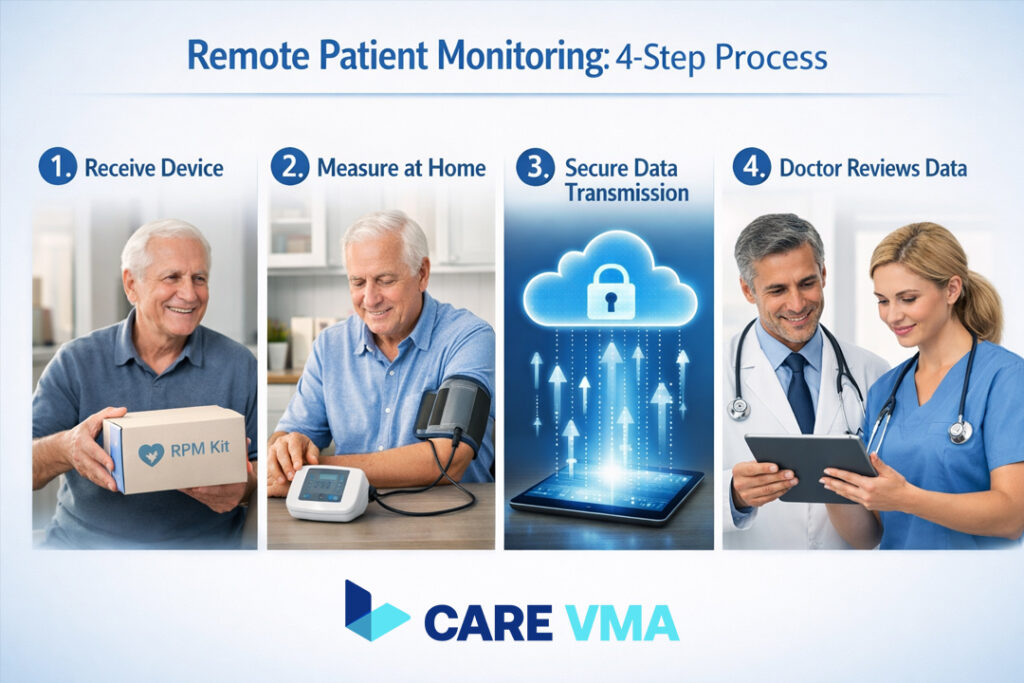
At first glance, the technology might sound complicated, but the process is designed to be incredibly simple and reassuring for the patient. Think of it less like a complex medical procedure and more like a seamless, automatic daily check-in with your nurse.
Here’s the thing: you don’t need to be a tech expert to benefit. The entire system is built around ease of use.
Step 1: Receiving Your Pre-Configured Device
Your healthcare provider determines that RPM is a good fit for you. You will then receive one or more medical devices, such as a blood pressure cuff, a weight scale, or a blood glucose meter. These devices are typically ready to use right out of the box—no complicated setup required.
Step 2: Taking Your Daily Readings
As part of your daily routine, you use the device to take your measurements. This usually takes less than a minute. For example, you might check your blood pressure each morning after you wake up.
Step 3: Automatic & Secure Data Transmission
This is where the magic happens. Modern RPM devices automatically transmit your physiologic data to your care team using built-in cellular technology. You don’t need Wi-Fi, a smartphone, or an app. The transmission is fully encrypted and HIPAA-compliant, ensuring your private health information stays secure.
Step 4: Review and Proactive Action by Your Care Team
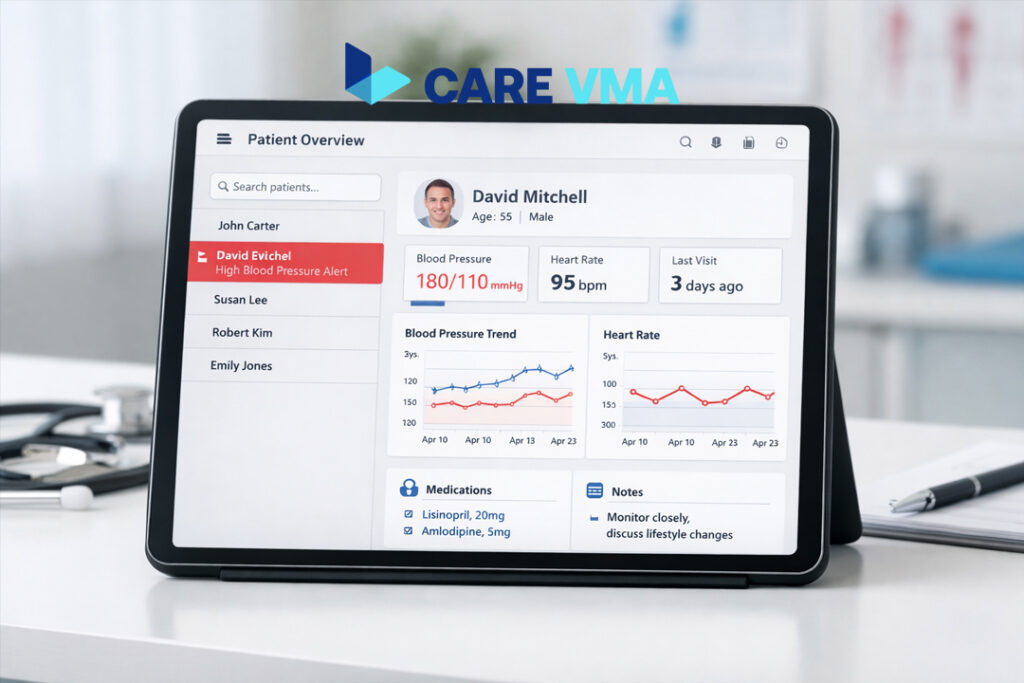
Your care team receives your data on a secure clinical dashboard. They aren’t just looking at numbers; they’re monitoring trends. If a reading is outside of your normal range, the system alerts them immediately. This allows for proactive care—a nurse might call you to check in, your doctor could adjust your medication, or they might schedule a telehealth visit, often preventing a trip to the emergency room.
Who is Remote Patient Monitoring For? Key Conditions We Monitor
While many people can benefit from this level of proactive care, RPM is a true game-changer for individuals managing specific chronic diseases. It’s not just about collecting data; it’s about what that data means for preventing a crisis.
High Blood Pressure (Hypertension)
For those with hypertension, daily monitoring provides a much clearer picture of what’s really happening than a single reading at the doctor’s office. It helps your provider see if your medication is working effectively and allows for timely adjustments, significantly lowering the risk of stroke and heart attack.
Congestive Heart Failure (CHF)
What most people don’t realize is that for a patient with Congestive Heart Failure (CHF), a sudden weight gain of a few pounds in a day or two is a major red flag for fluid retention. An RPM smart scale can detect this change days before the patient feels symptoms like shortness of breath, allowing the care team to intervene and often prevent a hospital stay.
Diabetes (Type 1 and Type 2)
Consistent monitoring of blood glucose levels is critical for managing diabetes. RPM glucometers provide a continuous stream of data, helping doctors and patients understand how diet, medication, and lifestyle affect glucose levels. This leads to better A1c control and a reduced risk of long-term complications.
Chronic Lung Diseases (COPD & Asthma)
For patients with conditions like COPD, a pulse oximeter can monitor oxygen saturation levels from home. A dip in these levels can be an early indicator of an exacerbation, prompting a quick intervention from the care team to adjust treatment and avoid an emergency.
Post-Surgical Recovery
After a major surgery, monitoring vital signs is crucial for a safe recovery. RPM allows the surgical team to keep a close eye on your blood pressure, heart rate, and oxygen levels from home, helping to spot potential complications like infections or blood clots early.
The Real-World Benefits: More Than Just Data
The true value of RPM isn’t in the technology itself, but in the human outcomes it produces. It delivers tangible benefits for both the people receiving care and the dedicated professionals providing it.
For Patients: Peace of Mind and Better Health
Living with a chronic illness can be isolating and frightening. RPM changes that dynamic by creating a constant, reassuring connection to your care team. The results are profound:
- Fewer emergency visits and hospital stays: According to the National Institutes of Health (NIH), RPM programs have been shown to significantly reduce hospital readmissions for conditions like heart failure.
- Greater control and understanding of your own health: Seeing your numbers every day empowers you to connect your lifestyle choices to your health outcomes.
- The convenience of care at home: Reduces the stress, time, and cost associated with frequent travel to a clinic.
- A stronger, more trusting connection to your care team: You feel seen and cared for, not just during appointments, but every single day.
For Healthcare Providers: Smarter Workflows and Better Outcomes
Provider burnout is a critical issue, often fueled by overwhelming administrative tasks and unmanageable patient loads. RPM, when done right, doesn’t add to the burden—it lightens it.
- Early detection of patient decline: Move from reactive to proactive care by catching problems before they escalate.
- Actionable insights, not just data overload: The right platform filters the noise and highlights only the patients who need immediate attention.
- Improved efficiency for clinical teams: Manage a larger patient population more effectively, freeing up nurses to focus on critical-care tasks.
- Better patient adherence and satisfaction: Engaged patients are healthier patients, leading to improved outcomes and higher satisfaction scores.
The promise of RPM is clear, but its success hinges on implementation. For providers feeling overwhelmed by data, and for patients who are wary of technology, the right partner makes all the difference. Learn how Care VMA’s human-centered approach simplifies Remote Patient Monitoring.
The Care VMA Difference: RPM Made Simple and Human
Not all RPM solutions are created equal. The difference between a program that causes more work and one that delivers genuine peace of mind often comes down to one thing: a focus on the human experience. Here’s the thing: technology is only helpful if people can and will use it. That’s our core philosophy.
We recognized the two biggest hurdles to successful RPM: patient technology anxiety and provider data fatigue. We built our solution to solve them.
- For Patients: “Plug-and-Play” with a Helping Hand We eliminate the fear of technology. Our RPM devices arrive pre-configured and ready to go. There are no apps to download or Wi-Fi to connect. For those who still feel hesitant, our dedicated support team is available to walk them through the process, ensuring they feel confident and cared for. We provide “peace of mind as a service,” not just a piece of hardware.
- For Providers: From Data Noise to Clinical Signal We believe a provider’s time is best spent on patient care, not sifting through endless data points. Our intelligent platform doesn’t just show you raw numbers; it uses smart alerts to highlight the 5-10% of patients who truly need your attention today. This transforms overwhelming “data noise” into a clear, actionable “clinical signal,” preventing burnout and making your team dramatically more efficient.
Here’s a real-world example: Dr. Evans, running a busy cardiology practice, was concerned that launching an RPM program would overwhelm her nursing staff. With Care VMA, her team now starts each day with a clear, prioritized list of patients flagged by the system. They can effectively manage over 100 RPM patients in just an hour of focused work, leading to fewer crisis calls and better patient outcomes.
Is Remote Patient Monitoring Covered by Insurance and Medicare?
This is one of the most important questions for both patients and providers, and the answer is overwhelmingly positive.
Yes, in many cases, Remote Patient Monitoring services are covered by Medicare Part B and a growing number of private insurance plans, especially for patients with at least one chronic condition. The Centers for Medicare & Medicaid Services (CMS) has recognized the value of RPM in improving outcomes and has established specific CPT codes for reimbursement.
There are certain requirements, such as needing to transmit data on at least 16 days out of a 30-day period. However, a well-managed program with an intuitive platform like Care VMA helps track this automatically, ensuring compliance for billing is straightforward for your practice.
Getting Started with RPM: What to Expect
Embracing proactive health monitoring is a significant step, but the journey to get there is simpler than you might think.
- Talk to Your Doctor: The first step is a conversation with your healthcare provider to see if RPM is the right fit for managing your condition.
- A Simple Enrollment Process: If you are a good candidate, your clinic will enroll you in their RPM program. This involves giving consent and confirming your details.
- Receive Your Easy-to-Use Devices: Your pre-configured devices will be shipped directly to your home, ready to use immediately.
- Begin Your Journey to Proactive Health: Simply start taking your daily readings and rest easier knowing your care team has a watchful eye on your health.
Taking control of a chronic condition is a powerful feeling. A comprehensive approach often involves combining different care strategies. For instance, many practices find that a program combining Chronic Care Management (CCM) with RPM provides the most holistic support for patients.
Frequently Asked Questions (People Also Ask Optimization)
Still have questions? You’re not alone. Here are answers to some of the most common queries we hear about Remote Patient Monitoring.
What is the difference between telehealth and remote patient monitoring?
Telehealth is a broad term for all remote healthcare services, including things like video consultations with your doctor. Remote Patient Monitoring (RPM) is a specific type of telehealth that focuses exclusively on using medical devices to collect and transmit physiologic data automatically.
Is my health data safe with RPM?
Absolutely. Patient privacy is the highest priority. Legitimate RPM systems like Care VMA use secure, encrypted, and HIPAA-compliant platforms to transmit and store your data. Your information is protected by the same strict standards as the records in your doctor’s office.
Do I need Wi-Fi or a smartphone to use RPM devices?
Not always. This is a common misconception that creates a barrier for many. To ensure accessibility for everyone, many of the most effective RPM devices, including those used by Care VMA, come with their own built-in cellular connectivity. They work automatically without needing any existing internet connection or technical setup from the patient.
From Worry to Confidence: The Future of Your Health
Remote Patient Monitoring is fundamentally shifting chronic disease management from a reactive, appointment-based model to a proactive, continuous-care partnership. It isn’t about replacing your doctor; it’s about strengthening your connection with your entire care team. It’s about giving you the peace of mind that comes from being seen and supported every single day, and the control that comes from truly understanding your own health.
Are you ready to move from a place of uncertainty and worry to one of confidence and empowerment in your health journey?
For Patients: Start a conversation with your doctor about whether Remote Patient Monitoring is right for you.
For Healthcare Providers: Discover how a simple, human-focused RPM platform can reduce staff burnout, improve patient outcomes, and strengthen your practice.