Here is a reality most clinic owners face but rarely talk about: the more patients you try to help, the more the administrative mountain threatens to bury your practice. You started this journey to practice medicine, yet you likely spend half your day wrestling with insurance denials and data entry.
For small clinics, 24 hours is never enough. The phones ring off the hook, the EMR charts are lagging behind, and your in-office staff is perpetually overwhelmed.
This administrative friction does more than cause burnout; it bleeds your revenue dry. Every missed call is a lost patient, and every unverified insurance claim is a potential write-off. When your physical staff is stuck on hold with insurance companies, they aren’t engaging with the patients right in front of them.
There is a smarter way to scale. By delegating approximately 40% of your non-clinical operations to a specialized professional, you can reclaim your time and reduce overhead by up to 70% compared to traditional in-person hiring.
A Virtual Medical Assistant (VMA) for small clinics is a remote, HIPAA-trained professional dedicated to managing a practice’s administrative and operational tasks, such as EMR data entry, appointment scheduling, and insurance verification. Unlike general assistants, VMAs possess specific healthcare training and function as an integrated extension of the clinical team to improve workflow efficiency.
This guide is built upon operational data from over 250 U.S. healthcare practices and incorporates efficiency benchmarks from the Medical Group Management Association (MGMA) regarding modern practice scalability.
What Exactly is a Virtual Medical Assistant (and Why Not a General VA)?

Here’s the thing: calling a VMA a “Virtual Assistant” is like calling a Registered Nurse a “clerk.” The distinction lies entirely in the training and the stakes.
In a medical environment, a mistake isn’t just an administrative hiccup; it’s a potential compliance violation or a patient care delay. A general VA might know how to manage a calendar, but they don’t understand the nuances of CPT codes, the sensitivity of PHI (Protected Health Information), or the critical nature of a Business Associate Agreement (BAA).
Think of it this way: you wouldn’t hire a general contractor to perform an EKG. Similarly, you shouldn’t trust your EMR data to someone who isn’t HIPAA-certified and healthcare-vetted.
- Medical Terminology: VMAs are fluent in the language of healthcare, ensuring chart notes are accurate.
- Software Proficiency: They come pre-trained in platforms like Epic, Athenahealth, eClinicalWorks, and Practice Fusion.
- HIPAA Compliance: They operate within secure, encrypted environments to ensure data integrity.
Comparison: General VA vs Medical VMA
- HIPAA Training: General VA (None) vs. Medical VMA (Mandatory/Certified)
- Clinical Workflow: General VA (Basic) vs. Medical VMA (Advanced/EMR-integrated)
- Specialty Knowledge: General VA (General) vs. Medical VMA (Cardiology, Derm, Pediatrics, etc.)
5 Crucial Tasks Your Clinic Can Delegate Today
It’s often hard to let go of control, but in many cases, delegation is the only path to growth. Here are the five most impactful tasks a VMA can take off your plate immediately.
1. Front Desk & Appointment Management
A ringing phone in a small clinic is the sound of opportunity, but it’s also a distraction. VMAs act as your virtual front desk, handling inbound calls, rescheduling appointments, and proactively filling gaps in your schedule. This significantly reduces no-show rates and keeps your patient volume consistent.
2. Medical Billing & Insurance Verification
Nothing kills a clinic’s cash flow faster than insurance denials. A specialized VMA verifies patient eligibility before the patient ever walks through the door. They handle prior authorizations and follow up on denied claims, ensuring you get paid for the work you’ve already done.
3. EMR/EHR Data Entry & Chart Preparation
Most doctors spend up to two hours on “pajama time”—charting at home after work. A VMA can handle the heavy lifting of data entry, updating patient histories, and ensuring every chart is prepared for the next day’s visits.
4. Virtual Scribing in Real-Time
By joining your patient encounters via a secure link, a virtual scribe can document the entire visit in real-time. This allows you to maintain eye contact with your patient instead of staring at a computer screen.
5. Patient Follow-up & Telehealth Support
A VMA can function as a “digital roomer” for telehealth visits, checking the patient’s tech and collecting intake info before you join. They also manage prescription refills and lab result communications, which are vital for enhancing patient care with medical virtual assistants.
Strategic Advantages: Moving Beyond Simple Cost Savings
While the financial numbers are compelling, the true value of a VMA is strategic. It’s about building a resilient practice that can compete with large hospital systems.
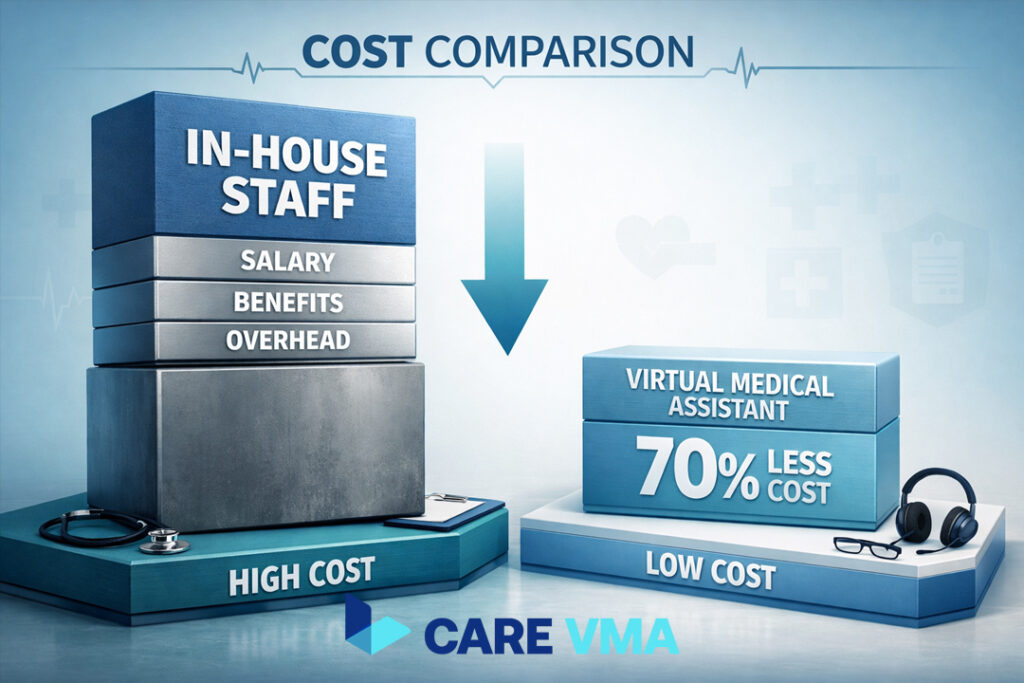
The ROI of a VMA The average cost of a full-time, in-person medical assistant in the U.S. ranges from $50,000 to $70,000 when you factor in benefits, payroll taxes, and overhead. In contrast, a VMA typically costs between $18,000 and $30,000. That’s a 70% reduction in staff overhead without sacrificing quality.
Burnout is the Practice Killer Recent data suggests that physician burnout solutions are no longer optional—they are essential for survival. By removing the 40% of the day spent on administrative “scut work,” doctors report higher job satisfaction and better clinical outcomes.
Seamless Scalability Small clinics often face “hiring friction”—the fear of adding a full salary when you only need 20 hours of help. VMAs offer the flexibility to scale up during busy seasons or scale down without the trauma of layoffs or physical office expansion.
The Care VMA Difference: We Don’t Just Provide Staff, We Optimize Results 🔥
Most agencies simply “headhunt” and leave the rest to you. At Care VMA Health, we realize that a small clinic doesn’t have time to be a full-time training center.
Onboarding in Under 2 Weeks Our process is built for speed and precision. We match you with an assistant who is already familiar with your specific EMR. Within 14 days, they are integrated into your workflow, often paying for themselves within the first 60 days through improved billing cycles and increased patient throughput.
Managed Performance We don’t just “place and forget.” Every VMA is overseen by a dedicated Account Manager who monitors KPIs and proactively looks for ways to improve your clinic’s efficiency. Our assistants are trained to be revenue optimizers, not just data entry clerks.
Case Study: A private practice in Ohio struggled with a 25% no-show rate and a backlog of unverified insurance. Within three months of partnering with Care VMA, their no-show rate dropped to 8% and their billing collections increased by 15% simply by ensuring every patient was pre-authorized.
Checklist: Choosing the Right VMA Provider
Not all providers are created equal. Before you sign a contract, ask these critical questions:
- HIPAA & BAA: Do they provide a signed Business Associate Agreement? (According to HHS.gov, this is non-negotiable for compliance).
- EMR Experience: Have they worked with your specific software (eClinicalWorks, Epic, etc.)?
- Retention Strategy: What is the assistant’s turnover rate? Stability is key for patient relationships.
- Price Transparency: Are there hidden “platform fees” or “setup costs”?
- Time Zone Alignment: Will they work live during your clinic hours?
Related Practice Resources
To further optimize your clinic, explore our expert guides on modern practice management:
- Virtual Medical Assistant vs. In-House Staff: A Head-to-Head Comparison
- 10 Essential Tasks for Healthcare Virtual Assistants
- Understanding HIPAA Compliance in Virtual Staffing
FAQ: What Clinic Owners Ask Most
How much does a Virtual Medical Assistant cost?
On average, a VMA costs between $10 and $15 per hour, compared to $25–$35 for in-person staff (including benefits). This translates to an annual saving of $30,000 to $40,000 per position.
Is my patient data safe with a VMA?
Yes, provided you use a reputable agency. Care VMA uses encrypted platforms and strict HIPAA protocols, including the mandatory signing of a BAA, to ensure patient confidentiality is never compromised.
Can they handle my specific EMR?
Most experienced VMAs are already proficient in major systems like Athena, Epic, and eClinicalWorks. During the onboarding process, we ensure they are trained specifically on your clinic’s custom shortcuts and workflows.
Conclusion
Stop trying to be a doctor and an office manager at the same time. The “solo-hero” model of running a clinic is the fastest path to burnout and stagnation. By leveraging a Virtual Medical Assistant, you aren’t just cutting costs; you are buying back the time you need to focus on what matters: the human being sitting in the exam room.
Not sure if your workflow is ready for a virtual transition? Discover the top 10 tasks our VMAs handle to see where you can start saving time today.
Ready to reclaim 15+ hours of your week and cut overhead by 70%? Join over 250 practices that have transformed their operations.