Is your practice constantly feeling the pressure of tight margins and overworked staff? You know Chronic Care Management (CCM) holds potential, but the reality of complex codes, manual time tracking, and the looming threat of clinical burnout makes it feel more like a liability than a revenue stream. Here’s the difficult truth: every month your practice struggles with an inefficient CCM process, you’re not just leaving thousands in reimbursement on the table; you’re actively risking patient attribution in value-based care models and missing critical opportunities to prevent costly hospitalizations. A strategic approach to CCM in 2026 isn’t about asking your team to work harder—it’s about empowering them to work smarter.
A Chronic Care Management (CCM) revenue strategy is a multi-faceted plan for medical practices to maximize reimbursement from Medicare for non-face-to-face care coordination. For 2026, this involves integrating new Advanced Primary Care Management (APCM) codes and combining CCM with services like Remote Patient Monitoring (RPM) to significantly boost profitability and patient outcomes. This guide is built on a rigorous analysis of the 2026 CMS final rules and operational data from dozens of practices that have turned their care management programs into powerful assets.
The 2026 CCM Landscape: More Than Just CPT 99490
Thinking of Chronic Care Management as just CPT code 99490 is a 2023 mindset. In 2026, the landscape has fundamentally changed, driven by CMS’s push towards proactive, non-visit-based care and reducing administrative friction. The core of CCM remains the same—providing at least 20 minutes of non-face-to-face care for patients with two or more chronic conditions—but the opportunities surrounding it have exploded.
The most significant shift is the adoption and expansion of Advanced Primary Care Management (APCM) codes. What makes APCM a game-changer? It moves away from the stopwatch. These codes provide a flat monthly payment for managing complex patients, eliminating the need to meticulously track and audit every minute of staff time, a major source of frustration and revenue loss.
To succeed, you must see these codes not as individual items but as a toolkit. Here’s a clear breakdown:
| Code | Description | Time Requirement | Estimated 2026 National Reimbursement |
|---|---|---|---|
| 99490 | Standard Chronic Care Management | First 20 minutes | ~$66 |
| 99439 | Add-on for Standard CCM | Each additional 20 min | ~$50 |
| 99487 | Complex Chronic Care Management | First 60 minutes | ~$144 |
| G0557 | Advanced Primary Care Management (APCM) | None (Monthly) | ~$48 |
| G0558 | APCM (High-Risk/Complexity) | None (Monthly) | ~$107 |
The Core Problem: Why Most In-House CCM Programs Fail or Underperform
Before we build the strategy for success, we have to be brutally honest about why so many well-intentioned CCM programs either fail to launch or fizzle out within months. The issue is rarely a lack of clinical skill; it’s almost always a breakdown in operations and strategy.
Does this sound familiar? Your most dedicated nurse spends more time with a stopwatch and a log sheet than engaging with a patient, all for a reimbursement that barely seems to cover their time. This operational friction creates three core problems that quietly sabotage your practice’s profitability and morale.
- Staff Burnout: Forcing your clinical staff—valuable RNs and MAs—to become “stopwatch administrators” is the fastest path to burnout. They didn’t enter healthcare to chase minutes. This leads to deep job dissatisfaction, rushed patient interactions, and ultimately, inaccurate time logging just to check a box.
- Pervasive Revenue Leakage: Here’s a fact most practices don’t realize: manual time tracking is notoriously inaccurate. Studies and our own data show that manual logs consistently under-report billable time by 20-30%. This means your team is providing the care, but you are not getting paid for a significant portion of it. It’s a slow, silent drain on your bottom line.
- Inefficient Patient Enrollment: When busy clinical staff are tasked with explaining the CCM program, including co-pays and service details, enrollment numbers plummet. They lack the dedicated time and specific training to handle patient questions and overcome objections, resulting in a small, stagnant program that never reaches a profitable scale.
The Multi-Pillar Revenue Strategy: How to Add $100k+ Per Provider
This isn’t about incremental gains. This is a multi-pillar strategy designed to fundamentally transform CCM from a burdensome administrative task into a significant, stable profit center. By layering services and choosing the right program for the right patient, practices can reliably add six figures in annual revenue per provider.
Pillar 1: Service Stacking – The RPM + CCM Power Combo
The most potent and immediate way to boost revenue is by concurrently billing Remote Patient Monitoring (RPM) and CCM. As validated by CMS guidelines, you can bill for both services in the same calendar month, provided the time and effort are documented separately.
- The Math: A standard CCM visit (99490) reimburses around $66. A typical RPM billing cycle (device setup + monitoring) can add over $100. Suddenly, that one patient is generating over $160 per month, more than doubling your revenue from that single interaction. For a deeper dive, read our guide on the benefits of remote patient monitoring.
Pillar 2: Tiered Care Management – Beyond “2 Conditions”
A one-size-fits-all approach leaves money on the table. Your patient panel isn’t uniform, and your care management strategy shouldn’t be either.
- For Single High-Risk Conditions (PCM): Have a patient with severe, uncontrolled heart failure but no other chronic diagnosis? Principal Care Management (PCM) is designed for them. It allows you to provide and bill for focused care coordination for patients who don’t meet the two-condition rule for CCM.
- For Value-Based Care Practices (APCM): If your practice is part of a VBC model like an MSSP ACO, APCM is your best friend. It provides stable, predictable revenue without the administrative nightmare of time-tracking, freeing your team to focus on proactive risk management and closing care gaps.
Pillar 3: The Strategic Pivot to APCM
APCM isn’t meant to replace CCM entirely; it’s a strategic tool. The ideal time to pivot a patient to APCM is when their care needs are more about consistent oversight and risk stratification rather than time-intensive monthly interventions. It stabilizes your revenue for patients who are high-risk but may not require a full 20 minutes of active coordination every single month.
Pillar 4: Stop Revenue Leakage in Value-Based Care
In models like MIPS or ACOs, patient attribution is everything. CCM is the “glue” that keeps your patients engaged and attributed to your practice. Regular, meaningful monthly touchpoints dramatically reduce the chances of a patient seeking care elsewhere. Furthermore, these calls are the perfect opportunity to coordinate in-network referrals, labs, and imaging, preventing the revenue leakage that costs health systems an estimated 10-30% of their potential income.
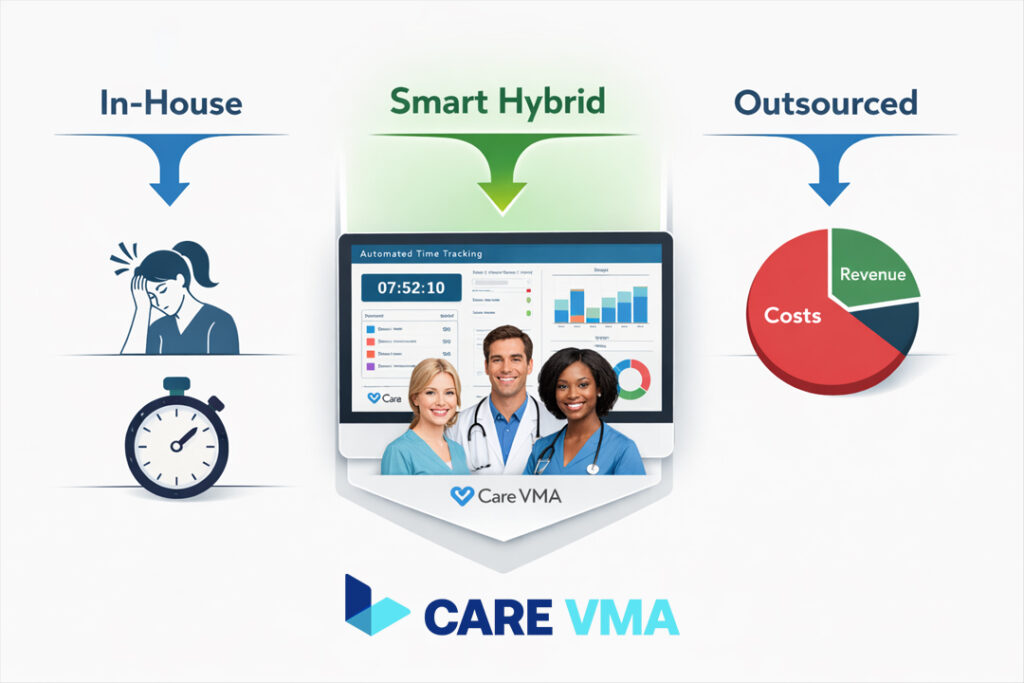
The Operational Model: In-House vs Outsourced vs The Smart Hybrid
Knowing the strategy is one thing; executing it is another. Many practices get stuck here, believing they only have two choices: a high-stress, in-house program or a low-margin, fully outsourced model. The reality is that the best solution for 2026 is a smart hybrid model, powered by the right technology.
An In-House model offers the highest profit margin but places a massive administrative and staffing burden on your practice. The Fully Outsourced model offers scalability but forces you to share a significant portion of the revenue.
The Smart Hybrid model, powered by Care VMA, offers the best of both worlds. It gives you the clinical control of an in-house program with the operational efficiency of an outsourced partner.
Here’s how the Care VMA platform specifically solves the core problems:
- We Eliminate the Stopwatch (Saving Time): Our platform integrates with your EHR and automates time tracking. The clock starts passively and accurately the moment your staff opens an enrolled patient’s chart, answers a portal message, or makes a call. This alone recaptures the 20-30% of billable time that is lost to manual under-reporting.
- We Centralize Everything (Reducing Workload): Instead of juggling different systems, a single Care VMA dashboard manages CCM, RPM, and APCM patients. Our Virtual Medical Assistants can handle the administrative setup, documentation, and billing alerts, allowing your clinical team to focus purely on patient care. This systematic approach is key to improving patient outcomes with effective chronic care management.
- We Empower Your Team (Increasing Efficiency): The Care VMA Hybrid model means your clinical staff handles high-value clinical conversations, while our trained virtual assistants manage the enrollment, scheduling, documentation, and compliance checks. You maintain full clinical control while shedding the administrative dead weight.
Use Case: A five-provider primary care group was billing CCM for only 60 patients, barely breaking even due to the staff time required. After implementing the Care VMA platform and our virtual assistant services for administrative tasks, they scaled to over 350 patients in four months with the same clinical staff. The program went from a headache to a six-figure profit center.
Financial Impact: A Conservative Revenue Projection
Let’s ground this strategy in real numbers. This is a conservative projection that demonstrates the power of stacking services.
- Assumptions: 100 Medicare patients enrolled in a stacked CCM + RPM program.
- CCM Revenue (CPT 99490): 100 patients x ~$66/month = $6,600
- RPM Revenue (e.g., 99454+99457): 100 patients x ~$100/month = $10,000
- Total Gross Monthly Revenue: $16,600
- Total Gross Annual Revenue: $199,200
This projection is for just the first 100 patients. A single provider can often manage a panel of 200-300 patients with the right support system, scaling this impact significantly.
Frequently Asked Questions
Can you bill for CCM and RPM in the same month?
Yes, absolutely. According to the National Institutes of Health (NIH) and CMS, you can bill for both CCM and RPM in the same month as long as the distinct requirements for each service are met and documented separately. The time spent on CCM activities must not be the same time spent on RPM activities.
What is the difference between CCM and APCM?
The main difference is the time requirement. Traditional CCM (like CPT 99490) requires a documented minimum of 20 minutes of clinical staff time per month. Advanced Primary Care Management (APCM) is a flat monthly payment for practice management activities without a specific time-tracking requirement, designed for practices in value-based care models.
Is starting a Chronic Care Management program profitable?
Yes, a CCM program can be highly profitable if executed strategically. Profitability hinges on three factors: efficient patient enrollment, accurate time capture (or the strategic use of APCM), and layering complementary services like RPM. Without an efficient operational system, a program can easily fail to cover the cost of the staff required to run it.
It’s Time to Transform Your Care Management Program
In 2026, running a successful Chronic Care Management program is no longer about meticulous manual time tracking. It’s about adopting a smarter, multi-pillar strategy that combines diverse revenue streams—CCM, RPM, PCM, and APCM—and empowering your staff with the right operational tools to eliminate administrative waste.
Stop letting regulatory complexity and operational friction prevent you from capturing the revenue you’ve earned and providing the proactive care your patients deserve. It’s time to start thinking of your CCM program not as a burden, but as your practice’s most valuable strategic asset.
Ready to see exactly how much revenue your practice is leaving on the table?