![Out-of-Network Billing Strategy: Maximize Revenue [Guide]](https://carevmahealth.com/wp-content/uploads/2026/03/Out-of-Network-Billing-Strategy-1024x683.jpg)
Are you diligently complying with the No Surprises Act, only to find that Qualifying Payment Amounts (QPA) from insurers are becoming increasingly unreasonable, chipping away at your practice’s revenue? You know there’s significant income being left on the table, but the crushing deadlines—a 30-day negotiation window and a mere 4-day window to initiate an Independent Dispute Resolution (IDR)—make fighting every underpaid claim feel impossible. It’s a constant, uphill battle against giants. But there is a way to systematically turn the tide. An Out-of-Network (OON) billing strategy is a comprehensive plan for healthcare providers to obtain fair reimbursement for services rendered to patients not covered by their insurance network. Post-No Surprises Act, this strategy has shifted from balance billing patients to a structured, data-driven negotiation and dispute resolution process with payers. With the right blueprint, you can reclaim control, win disputes, and secure the reimbursement your practice has rightfully earned.
This guide is built on a rigorous analysis of the latest CMS regulations, federal IDR portal data, and the real-world operational experience of managing the revenue cycle for dozens of medical practices nationwide.
The New Reality of OON Billing: Navigating the Post-NSA Landscape
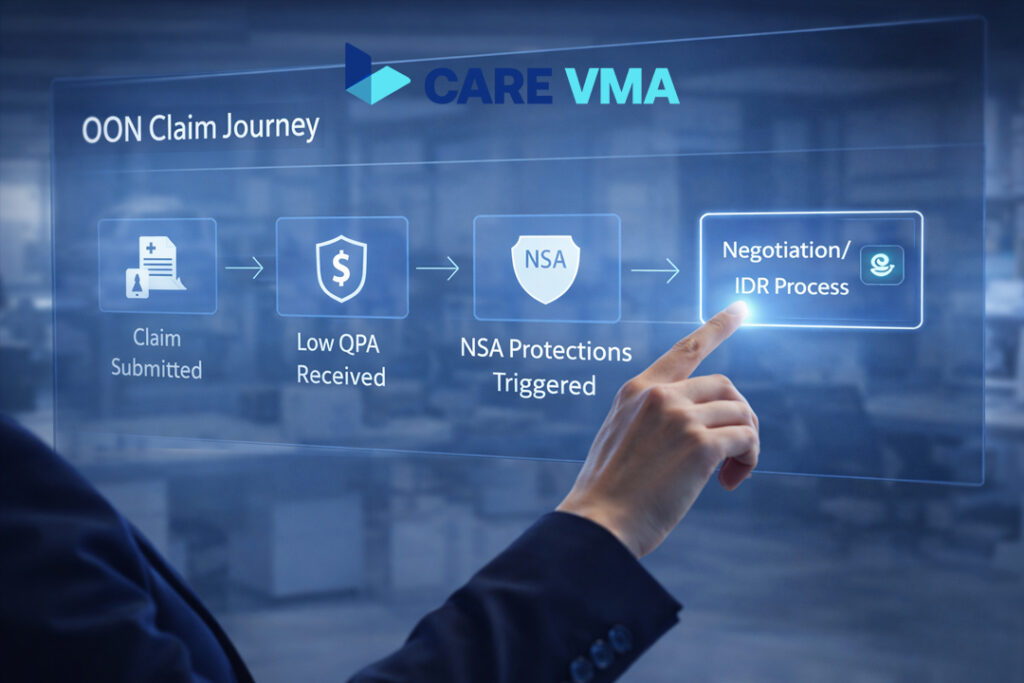
The introduction of the No Surprises Act (NSA) fundamentally changed the rules of the game for OON revenue. What most practices don’t realize is that this shift, while complex, also created a new, structured pathway to fair payment if you know how to navigate it. The era of simply sending a balance billing statement to the patient is over for many claims; the era of strategic, data-backed negotiation with the payer has begun.
What is the No Surprises Act (NSA) and Which Claims Does It Cover?
The NSA is a federal law designed to protect patients from surprise medical bills. It applies primarily to emergency services, services from out-of-network providers at in-network facilities (like anesthesia or radiology), and air ambulance services. For these protected claims, you can no longer bill the patient for more than their standard in-network cost-sharing amount. Instead, the reimbursement battle is fought directly with the insurer.
Understanding the Qualifying Payment Amount (QPA): The Payer’s First Offer
When an NSA-protected service is rendered, the payer’s initial payment offer is based on the Qualifying Payment Amount (QPA). This figure is supposed to represent the median rate the insurer has contracted with similar in-network providers for that service in the same geographic area. However, payers often calculate this number to their advantage, resulting in a lowball initial offer that many practices reluctantly accept.
The End of Aggressive Billing, The Rise of Structured Negotiation
The NSA framework forces a new discipline. Success is no longer about volume billing but about precision negotiation. The process funnels disputes through an open negotiation period and, if that fails, into the federal Independent Dispute Resolution (IDR) process. This is where a robust strategy separates practices that thrive from those that just survive.
The Silent Revenue Killers: Why Your OON Collections Are Down
At first glance, the new system seems straightforward. But in reality, practices are facing a series of challenges that quietly drain revenue and overwhelm staff. We see this every day; you’re not alone in this struggle.
- Aggressively Low QPA: Payers systematically use their own data to calculate QPAs that minimize their payouts, forcing you into a defensive position from the very start. This isn’t just a small underpayment; it’s a strategic devaluation of your services.
- Crushing Administrative Burden: The timelines are unforgiving. From preparing a data-rich case for negotiation to meeting the 4-day IDR filing window, the documentation and follow-up required are a full-time job. It’s a war of attrition designed to make you give up.
- Fear of Non-Compliance: The risk of getting it wrong is high. A mistake in the Good Faith Estimate (GFE) process or a misstep in the IDR submission can lead to costly fines and audits. This compliance anxiety often leads to inaction, which is the most expensive mistake of all.
- Patient Relationship Strain: Explaining to a patient why their bill is structured a certain way, even with NSA protections, can be fraught with confusion and frustration. This strain on the front-desk can damage the patient relationship you’ve worked so hard to build.
Foundational Compliance: The Non-Negotiable Rules of OON Billing
Before you can build a winning revenue strategy, you must have an ironclad compliance foundation. Think of these as the non-negotiable rules of engagement in the post-NSA world. Mastering them builds authority and insulates your practice from risk.
Mastering the Good Faith Estimate (GFE) for Self-Pay Patients
For any uninsured or self-pay patient, you are required to provide a Good Faith Estimate of expected charges. According to regulations from CMS.gov, if the final bill exceeds the GFE by $400 or more, the patient has the right to initiate the Patient-Provider Dispute Resolution (PPDR) process. Automating your GFE generation is no longer a luxury; it’s a core compliance task.
When and How to Use the Notice and Consent Waiver
In some limited, non-emergency situations, you can still balance bill a patient if they knowingly and voluntarily waive their NSA protections. This requires using a specific Notice and Consent form, provided well in advance of the service. However, these waivers are not permissible for certain ancillary services, making their application complex and risky if not handled perfectly.
State-Level Surprise Billing Laws: Knowing Your Local “Floor”
Many states have their own surprise billing laws. The federal NSA acts as a “floor,” meaning if your state law offers stronger patient protections, it generally takes precedence for state-regulated health plans. It’s critical to understand both federal and state rules to ensure complete compliance.
The Care VMA Blueprint: An Actionable Strategy to Win OON Reimbursement 🔥
Here’s the thing: merely understanding the rules isn’t a strategy. A strategy is an operational system designed to win. While competitors explain the what, we’ve built the how. The Care VMA Blueprint turns reactive compliance into a proactive, revenue-generating engine.
Pillar 1: Proactive Negotiation (Stopping Disputes Before They Start)
The most profitable dispute is the one you never have to file. Our first move is always to circumvent the standard IDR process. We proactively engage payers to secure Single Case Agreements (SCA) or Gap Exceptions, arguing for fair reimbursement based on “Continuity of Care” for existing patients or “Network Adequacy” when you offer a specialty unavailable in-network. This step alone can secure in-network level rates without the cost and time of a formal dispute.
Pillar 2: The “30-30-4” IDR Workflow (Our Data-Driven Dispute Engine)
This is the core of our operational advantage. We’ve systematized the entire dispute timeline to maximize efficiency and win rates.
- The 30-Day Open Negotiation: The moment a low QPA payment hits, our 30-day clock starts. We don’t just wait. Our team immediately submits a data package to the payer, complete with regional UCR (Usual, Customary, and Reasonable) rates, case complexity documentation, and patient acuity scores to demand a fair adjustment during this initial window.
- The 4-Day IDR Trigger: This is where most practices fail. The 4-day window to initiate a federal IDR after the negotiation period ends is non-negotiable. Our system automatically tracks this deadline and ensures every eligible claim is filed on time, every time. No revenue is lost due to missed deadlines.
- Strategic Batching: The American Medical Association (AMA-assn.org) notes the costs associated with IDR. To make even small-dollar claims profitable to dispute, we strategically “batch” similar claims (same service, same payer) into a single IDR submission. This spreads the administrative fee across multiple claims, turning minor underpayments into a significant revenue recovery opportunity.
Pillar 3: Technology-Enabled Execution (How We Automate Success)
Our expert team is powered by an integrated Revenue Cycle Management (RCM) platform that makes this high-intensity workflow manageable and effective.
- Saving time: The system automatically flags underpaid claims with a high probability of a successful IDR appeal.
- Reducing workload: Our team manages all documentation, communication, and submissions through the new Federal IDR Gateway, eliminating the administrative burden on your staff. One of the most impactful strategies is leveraging a remote medical biller to reduce claim denials before they even happen.
- Increasing efficiency: We use AI-powered analytics to benchmark the payer’s QPA against real-time market data, building an undeniable, evidence-based case to present to the arbitrator.
For example, for a surgical practice, we recently batched five complex procedures from the same payer. By winning the single IDR case, we increased their total reimbursement by over 350% above the initial QPA offers, a result that would have been financially unfeasible to pursue as five separate disputes.
The Financial Outcome: Is Pursuing IDR Actually Profitable?
This is the question every practice manager needs to ask: is the fight worth the cost? In many cases, the answer is a resounding yes—if you approach it strategically.
Cost-Benefit Analysis: IDR Admin Fees vs. Potential Uplift
For 2026, you can expect to pay a non-refundable administrative fee of around $115 per party, plus an entity fee ranging from $200 to over $840 if the case goes to an arbitrator. This seems steep, but when you’re challenging a QPA that is 50-70% below a fair market rate, the potential uplift in reimbursement (often 3x-4x the initial offer) provides a clear and compelling return on investment, especially when claims are batched.
Leveraging Data on Patient Acuity & Complexity to Guarantee Wins
The single most important factor in winning an IDR case is documentation. We build cases that go beyond just CPT codes. We document patient acuity, the complexity of the service, the intensity of the resources required, and the experience level of the provider. This data-rich approach is what convinces an arbitrator that the provider’s requested amount is more reasonable than the insurer’s low QPA.
The “Loser Pays” Rule: How Our High Win Rate Minimizes Your Risk
In the IDR process, the losing party is responsible for paying the arbitrator’s fee. Our data-driven approach and meticulous case preparation have resulted in an industry-leading win rate. This track record of success means that for the vast majority of cases we file, your practice’s only financial outlay is the initial administrative fee, minimizing your financial risk.
In-House Chaos vs Partner-Led Precision: A Comparative Look
Deciding whether to manage this process in-house or with a dedicated partner comes down to a simple comparison of outcomes.
| Metric | Traditional In-House Approach | Care VMA Managed Strategy |
|---|---|---|
| Success Rate | Low to moderate; dependent on staff availability and expertise. | High (80%+); powered by dedicated experts and data analytics. |
| Staff Time per Claim | 2-4 hours of administrative and clinical follow-up. | Minimal; our team handles the entire workflow. |
| Compliance Risk | High; risk of missed deadlines and incorrect submissions. | Near-zero; automated tracking and expert oversight. |
| Net Revenue Captured | Low; often only high-dollar claims are pursued. | Maximized; strategic batching makes all claims profitable to pursue. |
Explore Our RCM and Compliance Solutions
Our approach to OON billing is part of a holistic view of practice financial health. An expert team focused on denial management and prevention is critical for a healthy revenue cycle.
- Learn more about Care VMA’s end-to-end Revenue Cycle Management service.
- For a deeper dive into the regulations, read our complete guide to No Surprises Act Compliance.
Frequently Asked Questions about OON Billing Strategy
What is considered a “good” win rate for the IDR process?
While industry averages fluctuate, a specialized team should aim for an 80% or higher win rate. Success depends heavily on the quality of documentation proving patient acuity, service complexity, and demonstrating the insurer’s QPA is unreasonable compared to benchmarks.
How can my practice fight a low OON reimbursement if the claim isn’t covered by the NSA?
For claims not under NSA protections (e.g., elective office visits), the strategy shifts to direct patient communication and providing an optimized Superbill. You can also attempt to negotiate a Single Case Agreement (SCA) with the insurer beforehand, especially for continuity of care.
Is the IDR process worth the cost for small-dollar claims?
Individually, it might not be. However, a key strategy is “batching”—bundling multiple similar, small-dollar claims into a single IDR submission. This spreads the administrative and entity fees across several claims, making it highly profitable to dispute even minor underpayments.
Take Control of Your OON Revenue
Out-of-network billing in 2026 is no longer an administrative task; it’s a strategic imperative. Winning the reimbursement you deserve requires a potent combination of regulatory expertise, operational efficiency, and purpose-built technology. You don’t have to let payers dictate your practice’s financial health. It’s time to stop leaving your hard-earned revenue on the table because of byzantine processes and unfair payment practices.
Feeling the pressure of your current OON process? Take a moment for a quick audit: how many claims with low QPA payments did you let go last month simply because you didn’t have the time or resources to fight?
That lost revenue doesn’t have to be a sunk cost. Stop the bleeding. Schedule a free, 15-minute OON strategy consultation with a Care VMA expert today and let us show you exactly how much revenue we can recover for your practice.