
Are you watching your practice’s profitability slowly erode from simple billing errors? Is your in-house team constantly overwhelmed by a growing pile of claim denials, pulling them away from patient-facing tasks? This isn’t just a minor inconvenience. Every rejected claim and delayed payment creates a frustrating, expensive cycle that directly impacts your cash flow and adds to administrative burnout. Understanding the role of a Virtual Billing Specialist is the first, most critical step toward breaking that cycle and reclaiming control over your practice’s financial health.
A Virtual Billing Specialist is a remote professional responsible for managing the entire medical billing process, from submitting clean claims and managing denials to ensuring HIPAA compliance. They are a critical component of a modern healthcare practice’s Revenue Cycle Management (RCM), working to maximize reimbursements and optimize cash flow. This guide is built on an analysis of over 500 job descriptions and the stringent compliance standards set by industry authorities like the AAPC and AHIMA, ensuring you get the most accurate and actionable insights for 2026.
What is a Virtual Billing Specialist? The Core Role in Modern Healthcare
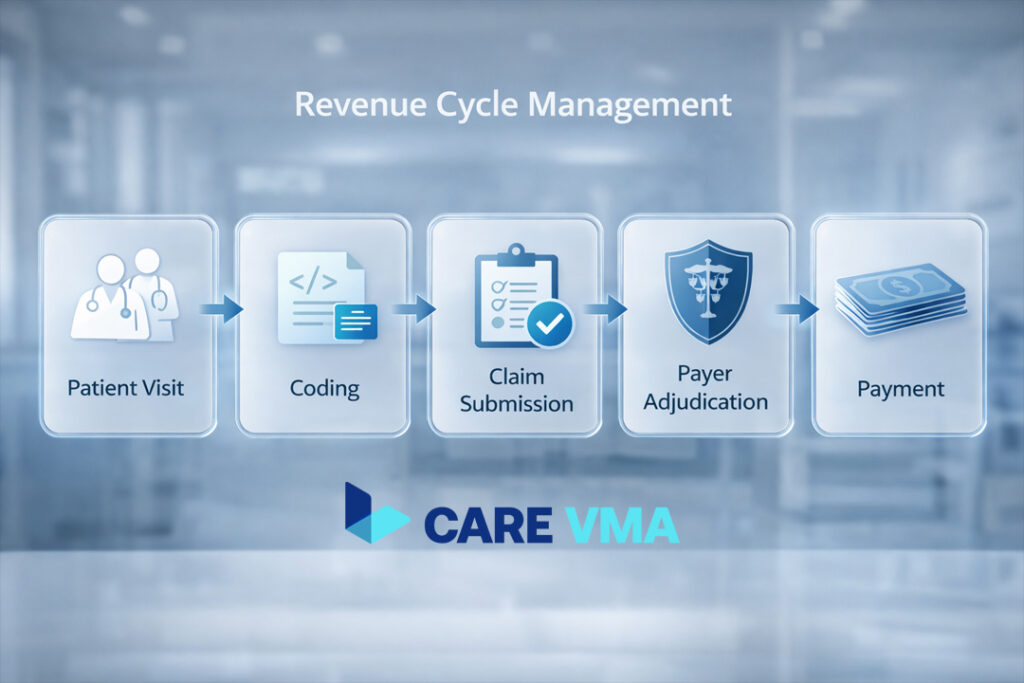
At first glance, it might be tempting to view this role as remote data entry. But in reality, a top-tier Virtual Billing Specialist is a strategic manager of your practice’s financial lifeline. They are the guardians of your revenue cycle, ensuring that the critical services you provide are properly documented, billed, and, most importantly, paid for.
This role is distinct from that of a Medical Coder. While a coder translates clinical services into standardized codes (like ICD-10 and CPT), the billing specialist takes those codes and masterfully navigates the complex reimbursement process. Their work involves meticulous claims submission, diligent follow-up, accurate payment posting, professional patient invoicing, and unwavering adherence to HIPAA compliance. They are the financial advocates for your practice, ensuring nothing falls through the cracks.
Key Responsibilities: The Day-to-Day of a Virtual Billing Expert
What does a Virtual Billing Specialist actually do all day? Their work is a dynamic blend of precision, investigation, and communication, all aimed at one goal: maximizing your practice’s revenue. Instead of just a list of tasks, think of each responsibility as a direct solution to a common administrative headache.
From Claim Submission to “Clean Claims”: The First Line of Defense
The single best way to get paid quickly is to submit a perfect claim the first time. Specialists “scrub” claims before submission, checking for errors in patient data, insurance information, and medical codes. This proactive quality control dramatically increases the clean claim rate, preventing countless denials before they ever happen and initiating a healthier revenue cycle management process.
The “Detective Work”: Mastering Denial Management
Even with the best preparation, denials happen. This is where a specialist truly shines. They don’t just see a denial; they see a puzzle to be solved. They investigate the root cause—was it a coding error, a lapse in coverage, or a need for prior authorization? Then, they systematically correct the issue and manage the appeals process, fighting to recover revenue that would otherwise be lost. This is a crucial part of denial management and prevention.
Closing the Loop: Accurate Payment Posting & Reconciliation
Once a payment arrives, the job isn’t over. A specialist meticulously posts payments from both insurers and patients, reconciling them against the original claims. This ensures your Accounts Receivable (A/R) is always accurate, giving you a true picture of your practice’s financial standing and preventing accounts from being incorrectly flagged as overdue.
The Financial Frontline: Patient Billing & Inquiries
The specialist often serves as a key point of contact for patients with billing questions. They handle these sensitive conversations with professionalism and empathy, explaining complex Explanation of Benefits (EOB) forms and setting up payment plans when needed. This preserves a positive patient experience while ensuring patient financial responsibility is met.
Essential Skills & Qualifications for a Top-Tier Specialist
Not all billing specialists are created equal. The most effective ones possess a powerful combination of technical knowledge and interpersonal skills that set them apart. Here’s what truly matters when evaluating talent.
Technical Proficiency (The “Must-Haves”)
- Medical Coding Fluency: Deep familiarity with ICD-10, CPT, and HCPCS codes is non-negotiable. They don’t have to be a certified coder, but they must speak the language fluently.
- EHR/PMS Software Mastery: Experience with major platforms is key. Look for proficiency in systems like Epic, eClinicalWorks, Athenahealth, or AdvancedMD.
- Clearinghouse Navigation: Knowledge of how to work with clearinghouses like Availity or Waystar to manage claims for multiple payers efficiently.
- Regulatory Knowledge: A rock-solid understanding of HIPAA, as well as the complex billing rules for government payers like Medicare and Medicaid.
Soft Skills (The “Difference-Makers”)
- Analytical Problem-Solving: The ability to look at denial data, see patterns, and recommend process improvements to the practice.
- Tenacious Communication: The persistence to stay on the phone with an insurance representative until a resolution is reached.
- Detail-Oriented Discipline: The focus required to work accurately and independently without direct, in-person supervision.
For added assurance, leading professionals often hold industry certifications like the CPB (Certified Professional Biller), which validates their expertise and commitment to the field.
The Care VMA Difference: Beyond the Standard Virtual Biller 🔥
Now that you understand the role, you might be thinking about hiring a freelancer or posting a job. But what most practices don’t realize is that simply hiring an individual often trades one set of problems for another—like management overhead, security risks, and inconsistent quality. This is where a managed solution creates a clear advantage.
The Care VMA model is designed to eliminate these challenges entirely.
- We Reduce Your Management Burden: You aren’t just hiring a specialist; you’re plugging into a fully managed team. Care VMA handles the recruiting, the rigorous training, and the continuous quality control. This frees you and your office manager to focus on high-value tasks like patient care and practice growth.
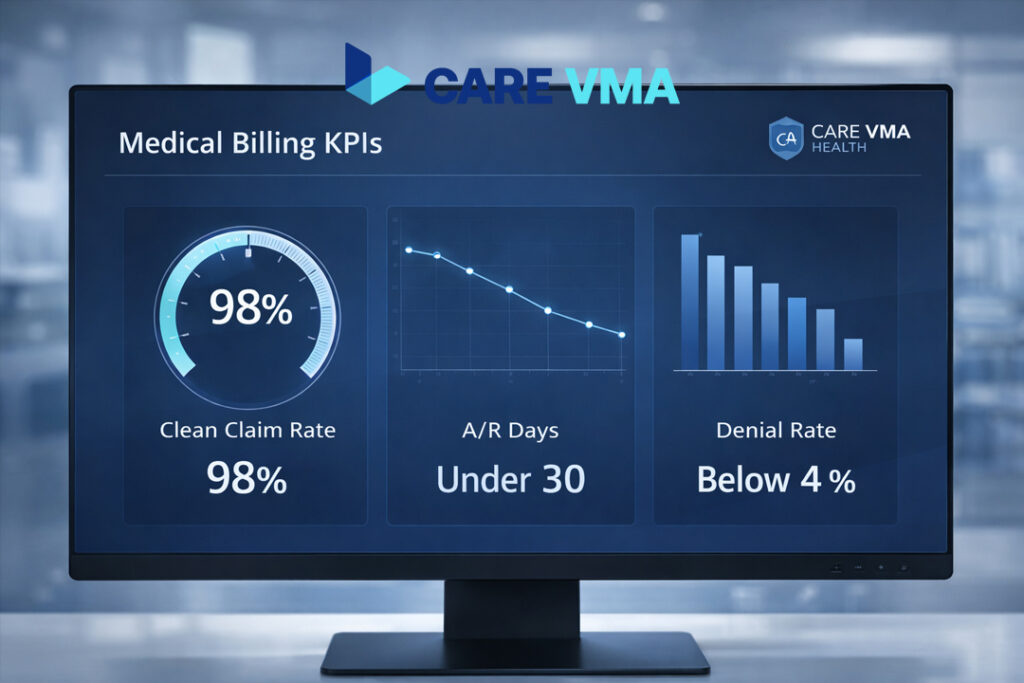
- We Drive Efficiency & Accountability: Our specialists are equipped with Care VMA’s standardized workflows and supported by our technology. Their performance isn’t a mystery; it’s tracked with clear metrics like clean claim rate and A/R days, giving you complete transparency and predictable results.
- We Guarantee Security & Compliance: Our entire infrastructure is built for strict HIPAA compliance. By working with a Care VMA specialist, you mitigate the significant security risks associated with independent contractors and ensure your patients’ sensitive data is always protected.
For example, one of our clients, a multi-provider orthopedic clinic, saw their average A/R days drop by 30% within 90 days. Our specialist identified a recurring denial pattern tied to a specific surgical modifier that their previous biller had repeatedly missed, recovering thousands in otherwise lost revenue. This is the difference between hiring a person and deploying a system.
The Financial Impact: Why This Role is Crucial for Your Practice’s Health
Ultimately, the decision to bring on a Virtual Billing Specialist is a financial one. Let’s translate their daily tasks into the bottom-line results that matter most to your practice.
- Direct Cost Savings: You eliminate the overhead costs associated with an in-house employee, including payroll taxes, benefits, office space, and hardware. A virtual assistant is different from an employee in ways that directly benefit your budget.
- Significant Revenue Growth: By increasing your clean claim rate and aggressively managing denials, a specialist directly accelerates your payment cycle. This improves cash flow, boosts your overall collection rate, and ensures you’re being paid the full amount you’re owed.
- Critical Workflow Improvement: By offloading the complex and time-consuming billing process, you empower your on-site staff to dedicate their full attention to the patient experience, from check-in to follow-up care.
Is Outsourcing Your Billing to a Virtual Specialist Right for You?
This solution is a game-changer for many practices, but is it the right fit for yours? Here’s a simple checklist to help you decide.
You should strongly consider a Virtual Billing Specialist if:
- Your claim denial rate is above the industry average of 5-10%.
- Your administrative staff seems to spend more time on billing than on patients.
- Your practice’s cash flow is unpredictable from month to month.
- You struggle to find, train, and retain qualified in-house billing staff.
- You are actively looking for ways to reduce operational costs without sacrificing quality.
If you checked two or more of these boxes, exploring a virtual solution could unlock significant efficiency and profitability for your practice.
Explore Our Healthcare Solutions
Understanding the Virtual Billing Specialist role is the first step. Now, see how this fits into a broader strategy for operational excellence.
- Learn more about optimizing your entire financial workflow in our guide to Revenue Cycle Management Best Practices.
- Ready to see how our specialists integrate directly with your team? Explore our dedicated Medical Billing Virtual Assistant Services.
- Discover how a specialist can also handle tasks like insurance verification and prior authorization to further streamline your front office.
FAQ (Frequently Asked Questions)
What is the average salary for a virtual medical billing specialist?
As of March 2026, the average full-time salary ranges from $47,000 to $60,000 annually, influenced by experience, certifications (like CPB), and area of specialty. However, partnering with a managed service like Care VMA is often more cost-effective, as it eliminates recruiting, benefits, and overhead costs associated with a direct hire.
Do you need to be certified to be a medical biller?
While not a strict legal requirement in all states, certification is the industry standard for excellence. Reputable managed services like Care VMA require specialists to hold credentials such as the Certified Professional Biller (CPB) from AAPC. This ensures they are experts in compliance, coding application, and payer requirements.
What is the difference between a medical coder and a medical biller?
A medical coder is a translator. They convert the details of a patient encounter—diagnoses, procedures, and supplies—into universal medical codes. A medical biller is a financial navigator. They use those codes to create and submit claims, manage the payment process, and resolve any issues with insurance payers.
Conclusion
A Virtual Billing Specialist is far more than a remote administrator—they are a vital steward of your practice’s financial well-being. By combining expertise in Revenue Cycle Management, tenacious denial management, and strict compliance, they ensure you are paid fully and promptly for the essential care you provide every day.
Stop letting billing complexities be a bottleneck to your practice’s growth. It’s time to transform this administrative burden into a strategic asset.
Ready to see the difference a managed, expert-led approach can make?
Schedule a Free Consultation with Care VMA Today to Analyze Your Revenue Cycle