This article is for informational purposes only and does not constitute medical or career advice. Please consult with a qualified professional for personalized guidance.
For physicians, the administrative burden of Electronic Health Records (EHR) is a relentless drain on time that should be spent with patients. For aspiring medical professionals, gaining meaningful, hands-on clinical experience is a formidable challenge. This dual pressure leads to widespread physician burnout on one side and a frustrating career bottleneck on the other. A crucial role has emerged as the definitive solution to both problems: the medical scribe.
A medical scribe is a healthcare paraprofessional who functions as a physician’s personal assistant, focusing primarily on real-time documentation of patient encounters directly into the EHR system. They are a vital part of the modern care team, enabling doctors to optimize efficiency and focus entirely on patient care.
What Exactly is a Medical Scribe?
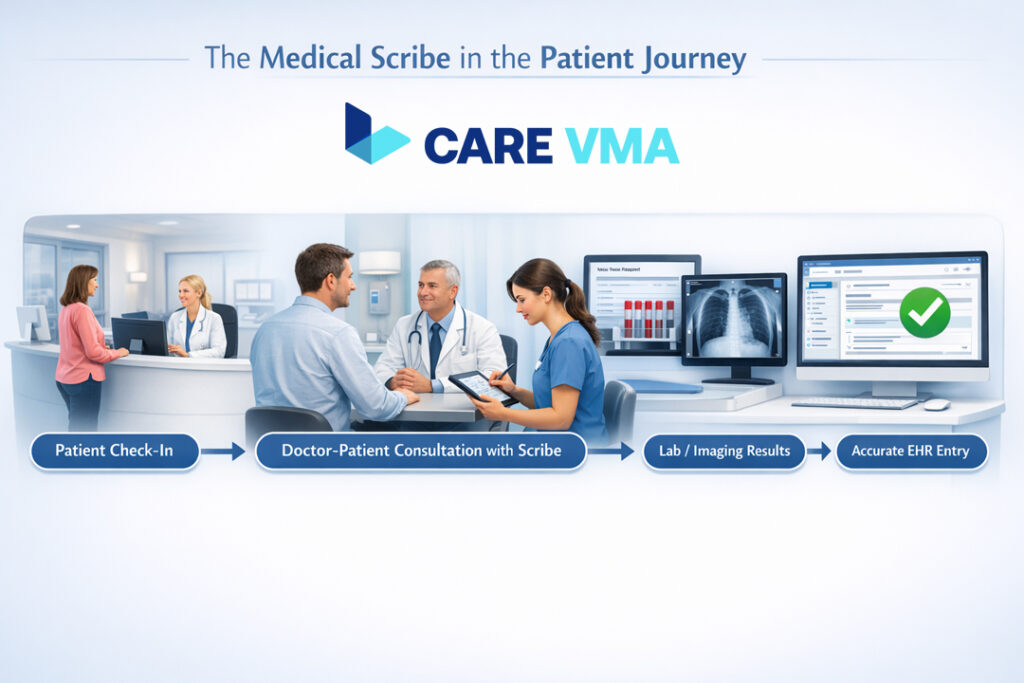
The role of a medical scribe was born from a critical need: to liberate physicians from the clerical tasks that have come to dominate modern medicine. With the mandate for digital records, doctors found themselves spending nearly as much time interacting with a screen as they did with their patients. The scribe restores that balance.
More Than Just a Medical Note-Taker
A scribe is far more than a typist. They are an information manager who understands the flow of a clinical encounter. They anticipate the physician’s needs, retrieve past medical records or lab results, and organize the patient’s story into a coherent, accurate medical-legal document.
The Primary Goal: Returning the Doctor’s Focus to Patient Interaction
The ultimate purpose of a medical scribe is to allow the physician to be fully present with the patient. By handling the documentation, the scribe enables direct eye contact, deeper conversation, and more thoughtful clinical decision-making, which fundamentally improves the quality of care.
The Medical Scribe’s Position in the Healthcare Team
A scribe works in direct partnership with a physician but is a key collaborator for the entire clinical team. They ensure the information documented is clear and accessible for nurses, medical assistants, and other providers involved in the patient’s care journey, ensuring seamless communication and continuity.
What Does a Medical Scribe Do?
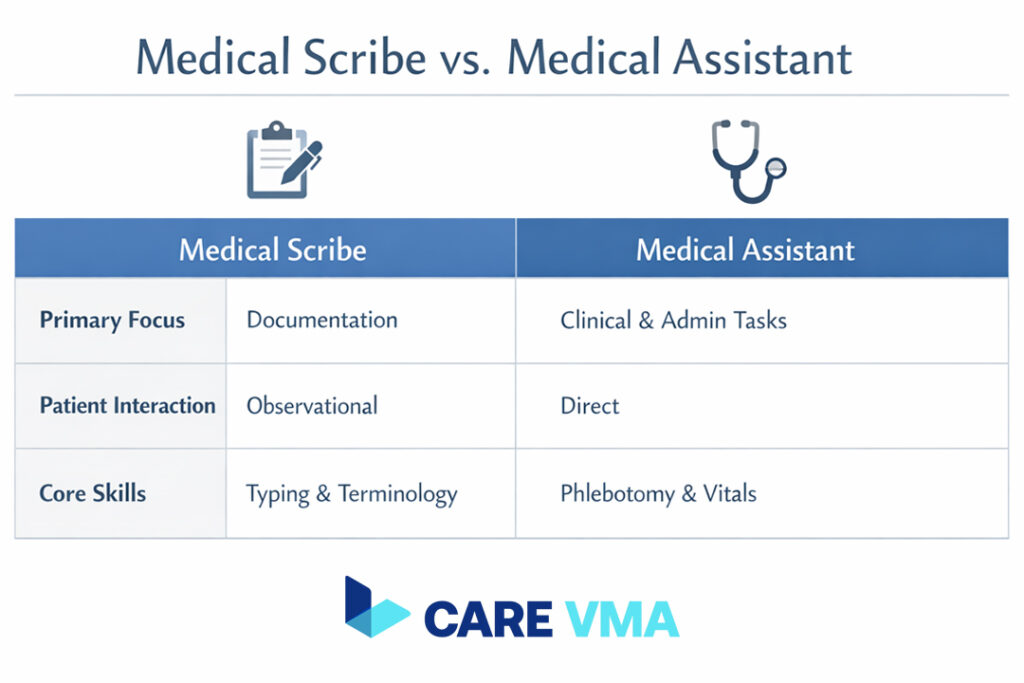
The daily responsibilities of a medical scribe are dynamic and centered around maximizing the efficiency and accuracy of the clinical workflow. Their tasks can be broken down into three core areas.
Real-Time Clinical Documentation
This is the central function of a scribe. As the physician examines and speaks with the patient, the scribe captures the encounter in the EHR, including:
- History of present illness (HPI), detailing the patient’s story and symptoms.
- Review of systems (ROS) and physical examination findings.
- Vital signs, lab results, and imaging interpretations.
Information Management and Administrative Support
Scribes act as a navigator for clinical data, ensuring the physician has the right information at the right time.
- Assisting in locating and retrieving past medical records, lab work, and diagnostic results.
- Preparing referral letters, prescriptions, and other clinical documents as directed by the physician.
- Managing and organizing the digital chart to ensure all information is up-to-date and easy to find, a key component of effective EHR & EMR Management: A Best Practice Guide [2026 Update].
Optimizing Clinical Workflow Efficiency
A proficient scribe helps orchestrate a more efficient clinic day. They can help the physician prepare for the next patient by queuing up their chart, allowing the doctor to move from one exam room to the next with minimal downtime.
The Tangible Impact of Medical Scribes on Physician Well-being
Physician burnout is a public health crisis, and administrative overload is a primary driver. Studies published by institutions like the Annals of Internal Medicine have shown that physicians can spend hours each day on EHR tasks, both during and after clinic hours. This is where medical scribes provide their most profound value.
The EHR Burden: A Thief of Time and Energy for Doctors
Navigating complex EHR interfaces, fulfilling documentation requirements, and managing in-basket messages consumes a massive portion of a physician’s day. This “pajama time”—work done at home after hours—detracts from personal life and is a leading cause of career dissatisfaction.
How Scribes Cut Down the Doctor’s “Homework” Time
By completing documentation in real time, a medical scribe ensures that when the last patient leaves, the physician’s work is largely finished. This simple change restores invaluable personal time, allowing doctors to rest and recharge. Integrating support is one of the most effective ways to explore How Medical Virtual Assistants Reduce Burnout in US Healthcare Practices?.
Case Study: Boosting Productivity and Physician Job Satisfaction
Numerous studies have demonstrated the positive impact of scribes. A systematic review in the American Journal of Emergency Medicine found that scribes were associated with significant improvements in physician productivity and satisfaction. Clinics often report that physicians with scribes can see one or more additional patients per hour, all while feeling less rushed and more engaged.
Why is Scribing the Ultimate Clinical Experience?
For anyone on a pre-health track—aspiring to be a physician, physician assistant, or nurse practitioner—working as a medical scribe offers an unparalleled educational and professional advantage.
Not Just Observing, but Engaging in the Clinical Thought Process
Scribing moves you from a passive observer to an active participant in the medical decision-making process. You hear the physician elicit a patient’s history, perform an exam, and articulate their differential diagnosis and treatment plan out loud. This experience trains your mind to think like a clinician long before you start professional school.
Building a Professional Network with Physicians
You work shoulder-to-shoulder with experienced physicians, building mentorships that can last a lifetime. These relationships often lead to powerful letters of recommendation that speak directly to your competence and dedication in a clinical setting.
Practical Skills Valued by Medical School Admissions Committees
Admissions committees are looking for more than good grades; they want proof of your commitment to medicine. Scribing provides tangible evidence of your capabilities, including:
- Mastery of medical terminology in a real-world, contextualized setting.
- Deep understanding of clinical workflows across various specialties, from the emergency department to outpatient clinics.
- Development of highly accurate and efficient documentation skills, a core competency for any future provider. This foundational knowledge aligns with topics discussed in “What Does a Medical Scribe Do in U.S. Healthcare?”.
Frequently Asked Questions
Hiring managers and aspiring scribes often have questions about the profession. Here are answers to some of the most common ones.
Do I need certification to become a medical scribe?
While not always mandatory, certification is highly recommended. It demonstrates a verified level of competence in medical terminology, documentation standards, and professionalism. Organizations like the American College of Medical Scribe Specialists (ACMSS) offer certification that can make you a more competitive candidate.
What are the primary qualifications needed?
Key qualifications include a fast and accurate typing speed (typically over 60 words per minute), a strong understanding of medical terminology and anatomy, meticulous attention to detail, and the ability to thrive in a fast-paced, high-pressure environment.
Where do medical scribes typically work?
Medical scribes are utilized across the entire spectrum of healthcare. They are most common in high-volume environments like emergency departments, urgent care centers, and busy specialty clinics such as orthopedics, cardiology, and oncology.
Conclusion & Next Steps
The medical scribe is a powerful, symbiotic role in the modern healthcare ecosystem. For healthcare practices, scribes are a proven strategy to increase operational efficiency, enhance revenue, and combat the critical issue of physician burnout. For individuals pursuing a career in medicine, it is the single most effective way to gain immersive clinical experience and build a competitive application for professional school.
This dual-solution role is not just a job; it is an integrated part of a forward-thinking, efficient, and provider-centric healthcare model.
- For healthcare facilities looking to dramatically improve physician satisfaction and operational throughput, discover how our team can support you. We invite you to consult with our experts on implementing our Virtual Medical Scribe Services.
- For ambitious individuals ready to take the most decisive step toward a career in medicine, explore the opportunities available through Care VMA and start your journey today.