
You entered medicine to heal patients, not to wrestle with fax machines or drown in data entry. Yet, the modern clinic manager often finds themselves spending more time navigating administrative bottlenecks than overseeing patient care. The reality of 2026 healthcare is harsh: phones are ringing off the hook, the waiting room is overflowing, and your best clinicians are eyeing the exit door due to burnout.
Clinic workflow optimization is the systematic process of analyzing and refining the daily tasks, information flow, and communication protocols within a medical practice to enhance efficiency, minimize clinical errors, and improve patient satisfaction. It is not merely about cutting costs; it is about reclaiming the time necessary to provide compassionate care.
This article is not a theoretical lecture on management. It is a comprehensive, actionable 7-step implementation guide designed to transform your practice from a chaotic, reactive environment into a streamlined, burnout-proof operation. By leveraging modern strategies and virtual support, we will help you identify the silent inefficiencies bleeding your revenue and endangering your patients.
Why Workflow Optimization is a Patient Safety Issue?
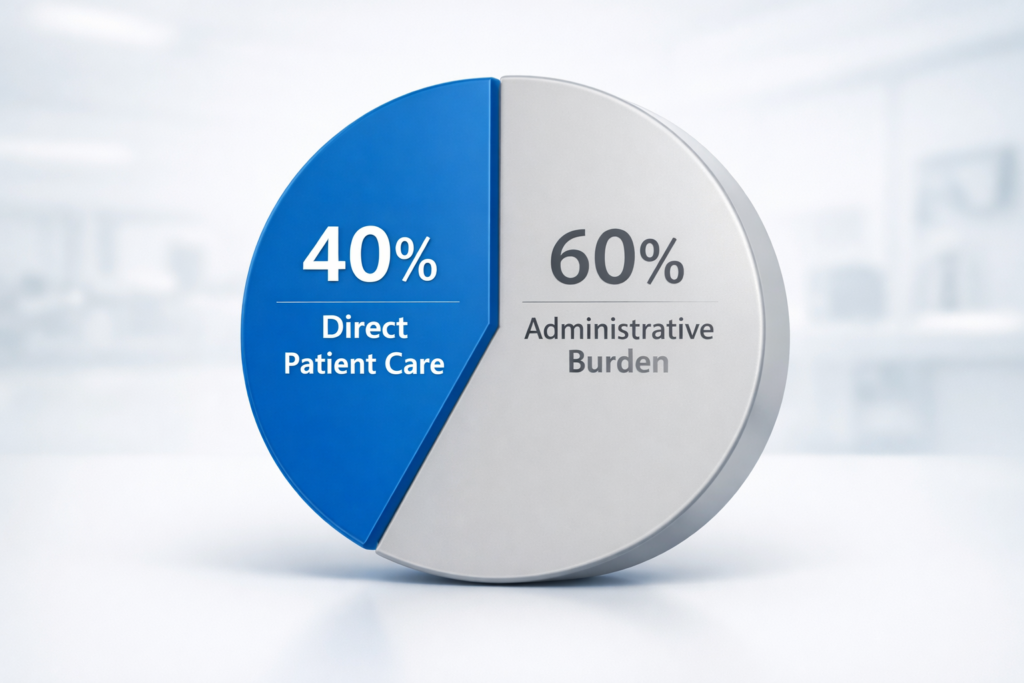
While many administrators view efficiency through a financial lens, the CareVMA Medical Review Team emphasizes that a disorganized workflow is a primary threat to patient safety. When processes are fragmented, the risk of error multiplies exponentially.
- Safety & Error Reduction: Fragmented communication channels are the leading cause of sentinel events. A streamlined workflow ensures that critical lab results and medication orders move linearly from the lab to the provider to the patient, without getting lost in a pile of paperwork.
- Staff Burnout Prevention: Cognitive overload is real. When a nurse has to click 20 times to document a simple procedure, their mental fatigue increases. Optimizing these steps is crucial to reduce burnout in US healthcare practices.
- Patient Satisfaction: In an era of consumer-driven healthcare, patients equate wait times with quality of care. An optimized front desk reduces friction, leading to better reviews and retention.
- Revenue Leakage: Inefficient billing and coding processes result in denials that could have been prevented. Integrating a medical billing virtual assistant into your workflow ensures claims are scrubbed and submitted accurately the first time.
Diagnosing the Malady: Common Clinical Workflow Challenges
Before prescribing a solution, we must accurately diagnose the operational ailments plaguing your practice. Based on extensive industry analysis, most clinics suffer from four distinct pathologies.
- Communication Breakdowns: The “telephone game” is dangerous in medicine. Relying on sticky notes or verbal hallway orders leads to missed instructions.
- Administrative Overload: High-volume practices often face a bottleneck of documentation. This is where the role of a virtual medical scribe becomes essential to free up provider hands.
- Inefficient Scheduling: Overbooking leads to long wait times, while no-shows destroy profitability. Without a robust system or a virtual medical receptionist to manage confirmations, the calendar becomes a source of chaos.
- Legacy Technology: Clinging to outdated, non-interoperable systems creates data silos where patient information becomes inaccessible when needed most.
7 Core Strategies for Workflow Optimization
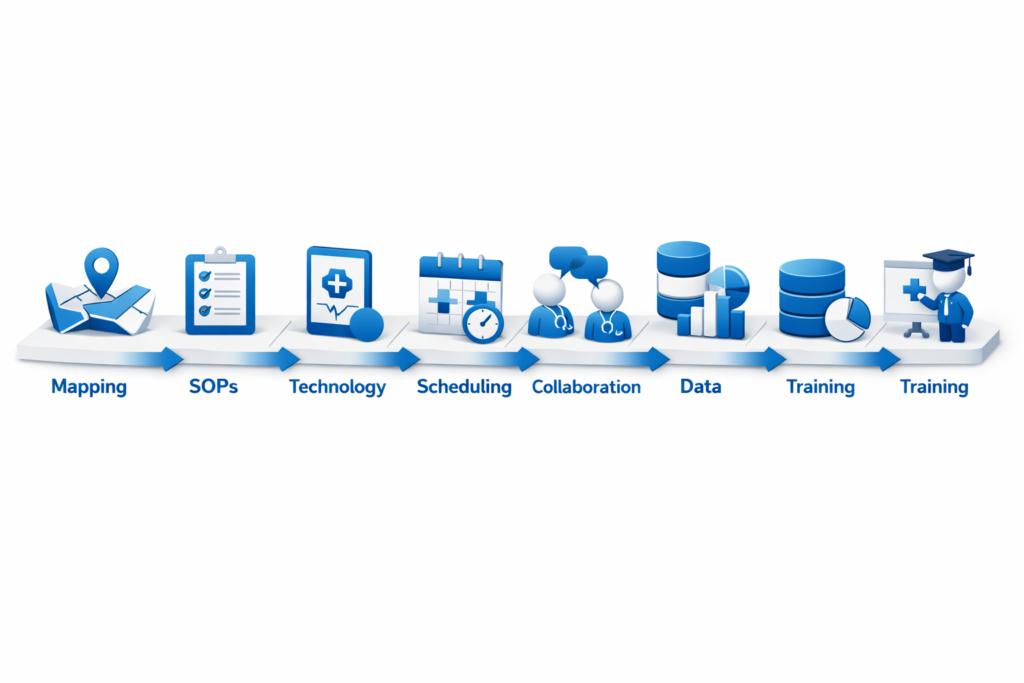
To move from chaos to clarity, we recommend implementing this 7-step protocol. These strategies are designed to be modular; you can implement them sequentially or tackle your biggest pain point first.
Process Mapping (The Diagnostic Scan)
You cannot fix what you cannot see. Begin by mapping every step of a patient’s journey, from the initial phone call to the final billing statement. Use a “swimlane” diagram to visualize handoffs between departments. You will likely find steps that are redundant or loops where data gets stuck.
Standardization of Protocols (SOPs)
Variability is the enemy of quality. If Nurse A and Nurse B perform patient intake differently, data consistency suffers. Create rigid Standard Operating Procedures (SOPs) for every routine task. This reduces the cognitive load on staff, as they no longer have to guess the correct procedure.
Implementation of Technology & Automation
In 2026, manual data entry should be obsolete.
- EHR Optimization: Customize your templates to match your specialty.
- Patient Portals: Empower patients to fill out history forms before arrival.
- AI & Automation: Use AI tools for predictive scheduling. To support this transition, many practices are choosing virtual assistant services for medical practice management to handle the tech-heavy lifting.
Capacity Management & Scheduling
Adopt “staggered” scheduling to prevent lobby overcrowding. Implement a digital queue system. For practices struggling with volume, utilizing a virtual patient care coordinator can ensure that slots are filled efficiently and cancellations are backfilled immediately.
Team Collaboration & Handovers
Implement a secure, centralized communication platform for your team. Shifts changes (handovers) are critical vulnerability points. Structured handoff protocols ensure that the incoming team is fully briefed on patient status.
Data-Driven Decision Making
Move beyond gut feeling. Track KPIs such as “Door-to-Doctor” time, “Denial Rate”, and “Third Next Available Appointment”. These metrics act as vital signs for your practice’s operational health.
Staff Training & Empowerment
Technology is useless if staff cannot use it. Invest in continuous training. Furthermore, cross-train your team so that a bottleneck in one area (e.g., the front desk) can be relieved by staff from another area during peak times.
Specific Areas to Optimize Immediately
If a total overhaul feels overwhelming, focus on these specific departments to see immediate results.
- Check-in/Check-out: Replace the clipboard with a kiosk or a tablet. Verify insurance eligibility in real-time. A remote admin assistant can handle the pre-registration process, ensuring the patient walks in with a “green light” status.
- Clinical Documentation: The burden of typing notes is a primary driver of burnout. Integrating virtual medical scribe services allows physicians to focus entirely on the patient while the scribe captures the encounter remotely in real-time.
- Patient Follow-up & Chronic Care: Managing patients with chronic conditions requires consistent monitoring. Implementing virtual chronic care management ensures these patients receive regular check-ins without clogging your daily schedule.
- Billing & Coding: Cash flow is the lifeblood of the practice. Use a remote medical coder to audit charts and ensure code specificity, reducing the lag time between service and payment.
The CareVMA Advantage: The Burnout-Proof Practice

Most workflow guides focus solely on speed. At CareVMA, we believe in the “Burnout-Proof Practice.” This philosophy acknowledges that human factors are just as critical as software settings. Here are three critical aspects often overlooked by competitors:
The Clinical Consequence of Administrative Lag
There is a direct correlation between administrative delay and patient safety events. When a lab result sits in an inbox for 48 hours because the nurse is too busy answering phones, the window for early intervention closes. Workflow optimization is, therefore, a risk management strategy. By offloading triage to remote triage nurse services, you ensure that critical symptoms are flagged immediately, regardless of how busy the front desk is. This layer of safety is absent in traditional, non-optimized models.
Change Management: Handling Staff Resistance
This is the most common point of failure. You can buy the best software, but if your senior staff refuses to use it, the optimization fails. Resistance often stems from fear that technology will replace them or make their jobs harder.
- The Solution: Involve staff in the selection process. Show them how a virtual medical assistant services partner handles the “grunt work” (faxing, scheduling, eligibility checks), allowing the in-house team to practice at the top of their license.
- Training: Do not just train on “how” to use the system, but “why” it matters. Demonstrate that the new workflow means they get to go home on time.
The “Pulse Check” Self-Audit
Before hiring expensive consultants, perform this simple audit. Ask your team three questions:
- “What task do you do every day that feels like a waste of time?”
- “Where do you constantly have to search for missing information?”
- “What is the number one reason patients complain?” If the answers point to repetitive administrative tasks, missing charts, or long hold times, your workflow is the problem. This immediate clarity allows you to deploy targeted solutions, such as hiring a 24/7 virtual medical receptionist to cure the phone line congestion.
FAQ: Critical Questions on Clinic Optimization
How long does it take to see results from workflow optimization? Initial changes, such as offloading phone duties to a virtual receptionist, yield results in days. However, a total transformation involving EHR optimization and culture change typically requires 3 to 6 months to mature.
Will AI and virtual assistants replace my current staff? No. The goal of using a virtual medical assistant is augmentation, not replacement. By removing repetitive tasks, your in-house staff can focus on direct patient care, phlebotomy, and relationship building—tasks that AI cannot do.
How do we start without a massive budget? Start with the “low-hanging fruit.” Identify the single biggest bottleneck—usually phones or intake. Outsourcing just this one function to a remote admin assistant is cost-effective and creates immediate breathing room to tackle larger projects.
Conclusion & Next Steps
An efficient workflow is not a luxury; it is the ethical foundation of a safe medical practice. When you strip away the administrative chaos, you reveal the core mission of your clinic: healing. Every minute saved on paperwork is a minute returned to a patient in need. Do not let outdated processes compromise your patient safety or your staff’s mental health.
The most effective way to begin this transformation is by alleviating the administrative burden immediately. CareVMA offers specialized virtual staffing solutions designed to plug directly into your practice and smooth out these friction points.
We strongly recommend exploring our Virtual Medical Assistant Services. This service is the “universal donor” for clinic optimization—capable of handling scheduling, intake, and admin tasks to instantly relieve pressure on your on-site team.
Stop drowning in administration. Contact CareVMA today to schedule your Free Workflow Audit and discover how our technology-driven, human-centric solutions can restore balance to your practice.