This article is for informational purposes only and does not constitute professional business or legal advice. Please consult with a qualified professional for guidance specific to your practice.
You became a physician to care for patients, not to get buried in paperwork and endless EHR data entry. Every hour spent on administration is an hour lost from patient interaction, practice growth, or valuable rest. This burnout is real and risky. Imagine safely and efficiently delegating up to 80% of that non-clinical workload. A Medical Virtual Assistant is a trained professional who provides remote administrative and clinical support for medical practices, allowing doctors and staff to focus on patient care.
Why Administrative Burden is a Critical Issue in 2026?
The operational landscape for medical practices has never been more challenging. The complexity of insurance claims continues to grow, EHR documentation demands are increasingly stringent, and patients now expect near-instant digital communication. This combination creates a perfect storm of administrative tasks that pull clinicians away from their primary purpose.
The Real Impact on Your Practice
- Reduced Face-to-Face Patient Time: When physicians spend hours on charting, they have less time for meaningful patient consultations.
- Risk of Staff and Physician Burnout: The relentless pressure of administrative work is a leading cause of burnout, a condition affecting over 50% of physicians, according to the National Institutes of Health (NIH).
- Inefficiencies Hindering Revenue Growth: Administrative bottlenecks slow down the revenue cycle, leading to delayed payments and lost income opportunities.
Administrative Tasks: The Foundation of an Efficient Practice
1. Appointment Scheduling and Calendar Management
A Medical VA manages all aspects of your schedule, including booking new appointments, handling reschedules or cancellations, and sending automated reminders to reduce no-show rates. This frees your front-desk staff to focus entirely on the patients physically in your office, improving their experience from the moment they walk in.
2. Patient Communication and Follow-Up
Your VA serves as a reliable first point of contact for incoming calls and emails. They can answer general inquiries, route urgent messages appropriately, and conduct post-consultation follow-ups to ensure patients understand their care plans. This systematic approach guarantees no patient message is ever missed, significantly boosting patient satisfaction.
3. Medical Billing and Insurance Support
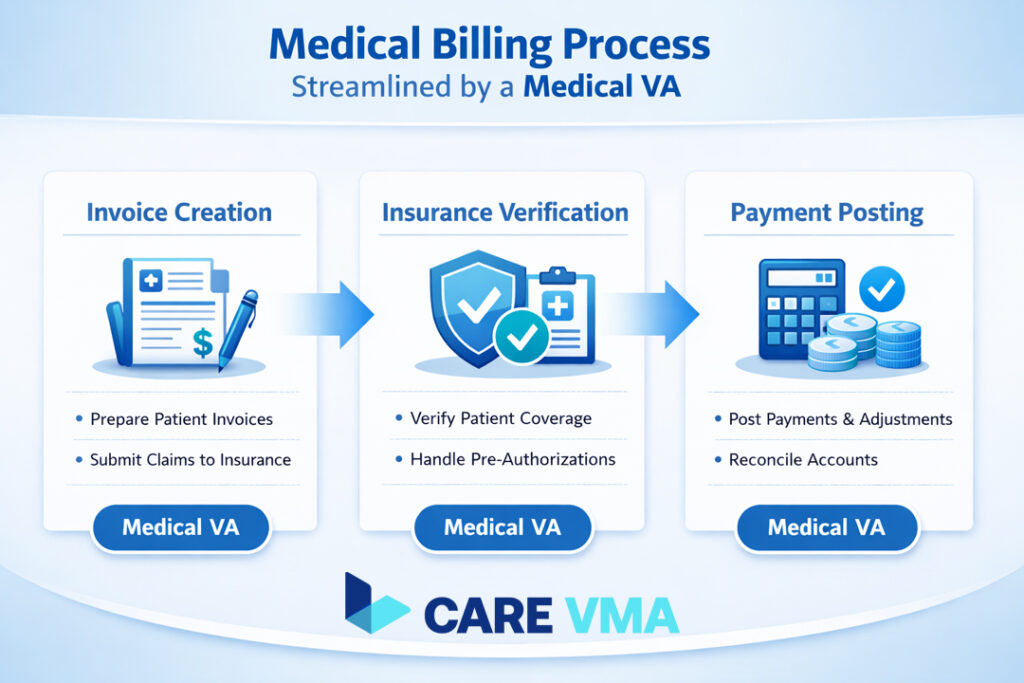
Medical VAs are crucial for maintaining a healthy revenue cycle. They can create invoices, track payments, and perform initial insurance eligibility checks. By handling the foundational work for Insurance Verification & Prior Authorization, they help accelerate payments and reduce the claim denial rate, directly impacting your bottom line.
4. Electronic Health Records (EHR) Management and Data Entry
One of the biggest time sinks for any physician is data entry. A Medical VA can update patient demographics, upload medical records, and input clinical notes dictated by the physician. Proper EHR & EMR Management saves clinicians countless hours each week, allowing them to leave the office on time without a backlog of charting.
5. Correspondence and Documentation Handling
Maintaining professional and organized communication is key. A VA can draft referral letters to specialists, send pre-procedure instructions to patients, and manage internal documentation. This ensures that the flow of information between your practice, your patients, and other providers is seamless and professional.
6. Telehealth Session Support
As telehealth becomes a standard of care, ensuring a smooth virtual experience is vital. A VA can manage virtual visit schedules, assist patients with technical issues, and guide them through the login process. This support creates a stress-free telehealth appointment for both the physician and the patient.
Clinical Support: Maximizing Physician Time
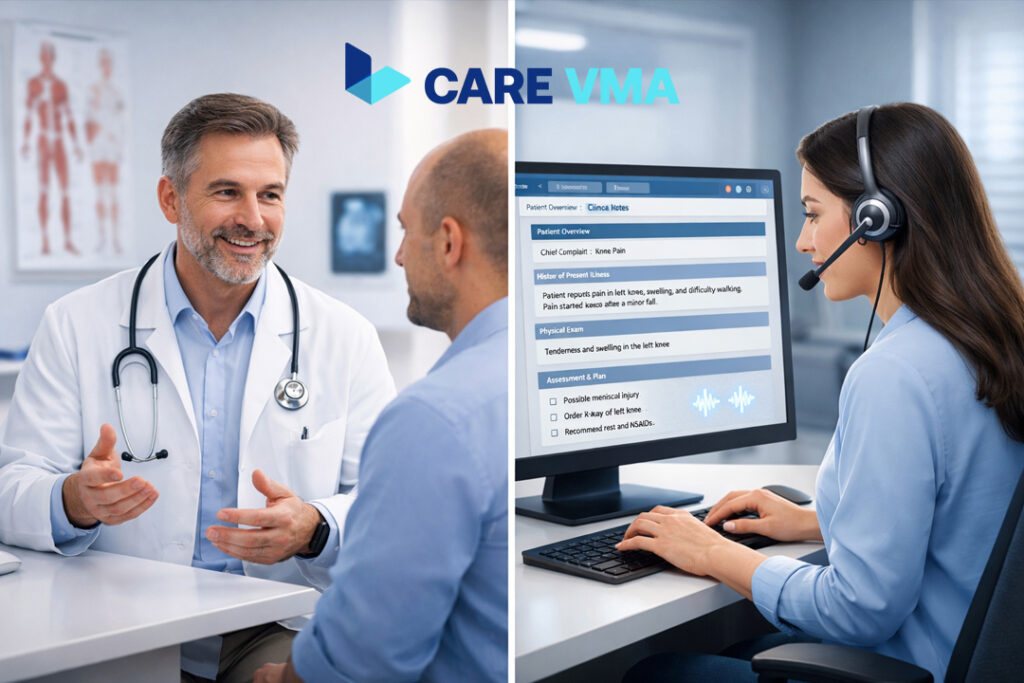
It is essential to note that these are “support” tasks performed under the direct supervision of a licensed medical professional. A Medical VA does not make independent medical decisions but rather executes tasks to make the clinician more efficient.
7. Scribing or Live Charting
During a patient visit, a virtual medical scribe can document the entire encounter in the EHR in real-time. This allows the physician to maintain eye contact and give their undivided attention to the patient. With an expert handling the documentation, as explained in “What is a Medical Scribe?,” the clinical note is accurate, complete, and finished the moment the visit ends.
8. Prescription Refill Coordination
A VA can manage incoming prescription refill requests from patients and pharmacies. They prepare the request within the EHR, verify details, and queue it for the physician’s final electronic signature and approval. This simple delegation removes dozens of daily interruptions, allowing the doctor to maintain focus on complex cases.
9. Patient Referral and Authorization Management
Coordinating care with other specialists can be a complex, manual process. A Medical VA handles the end-to-end workflow, from sending the initial referral to tracking its status and securing necessary pre-authorizations. Effective Referral Management ensures continuity of care is never delayed due to administrative hurdles.
10. Remote Patient Monitoring (RPM) Assistance
For practices offering RPM services, a VA can be instrumental. They can monitor incoming patient data from RPM devices, such as blood pressure or glucose levels, and flag any readings that fall outside of pre-set parameters for the clinical team’s review. This allows your practice to leverage the full benefits of Remote Patient Monitoring and provide proactive care without overwhelming your in-house staff, a practice supported by healthcare leaders like the American Medical Association (AMA).
A Smart Strategy to Integrate a Medical VA into Your Practice
1. Identify Your Practice’s Biggest “Time Sinks”
Start by auditing your daily workflows. Are you spending the most time on scheduling, EHR entry, or insurance follow-ups? Identifying the top 3-5 tasks that consume the most time will clarify exactly where a VA can provide the highest immediate value.
2. Ensuring Security and HIPAA Compliance
Patient data security is non-negotiable. It is critical to partner with a provider that prioritizes security. Care VMA ensures all VAs are fully trained in HIPAA Compliance & Data Security, operate on secure, encrypted networks, and sign strict non-disclosure agreements to protect your practice and your patients.
3. The Seamless Onboarding Process with Care VMA
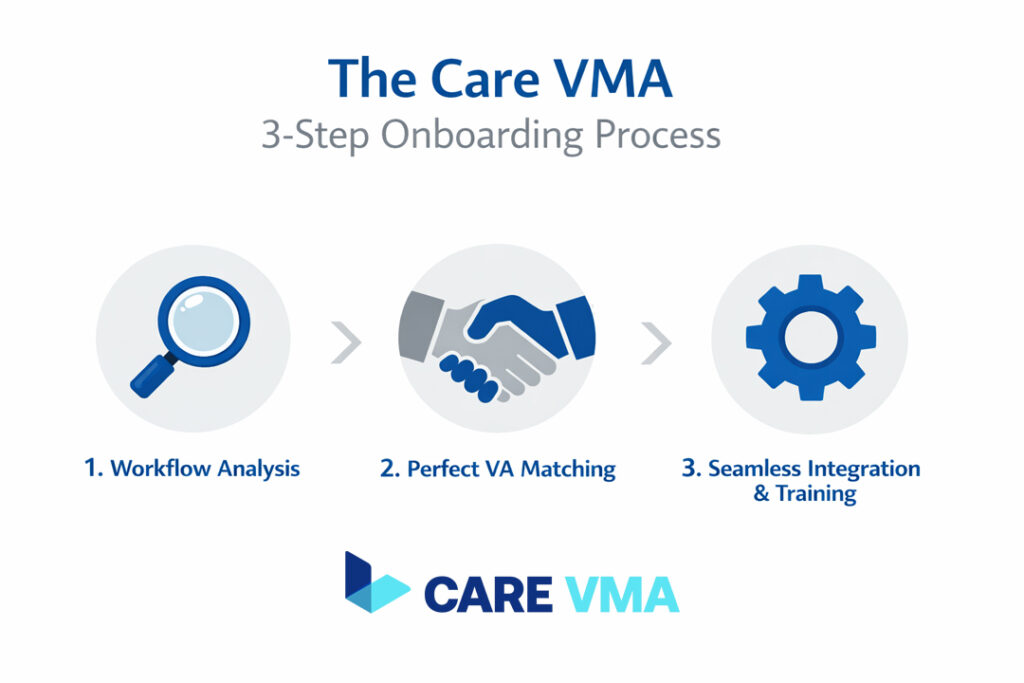
A successful integration requires a structured process. Care VMA’s onboarding includes matching you with a VA whose skills fit your needs, providing training specific to your EHR and workflows, and offering a supervised trial period to ensure a perfect fit. This strategic approach guarantees your VA is a productive team member from day one.
FAQ (Common Questions from Medical Practitioners)
Is it safe for a Medical VA to access our EHR?
Yes, with the right security protocols. Reputable VAs operate through secure, encrypted connections, are bound by NDAs, and have completed comprehensive HIPAA compliance training. Access is often role-based, limiting what they can see and do.
What is the difference between a Medical VA and in-office staff?
The primary differences are flexibility and cost-efficiency. A VA works remotely, which eliminates overhead costs like office space, hardware, and benefits. You can also scale their hours up or down, from part-time to full-time, to perfectly match your practice’s needs.
How long does it take to get started with a Medical VA?
It is typically much faster than a traditional hiring process. After an initial consultation to define your needs, the matching and onboarding process can often be completed within one to two weeks, allowing you to get the help you need without delay.
Conclusion & Next Steps
Stop letting administrative tasks dictate your day. Delegating these responsibilities is not a luxury; it is a critical strategy for practice sustainability, staff well-being, and delivering high-quality patient care in the modern era. By entrusting these 10 tasks to a skilled professional, you can reclaim your time and refocus on your true mission.
Ready to reclaim up to 15 administrative hours per week? Schedule a free 15-minute consultation with our Solutions Architect to analyze your practice’s workflow and discover how our Virtual Medical Assistant Services can help you refocus on what matters most: your patients.